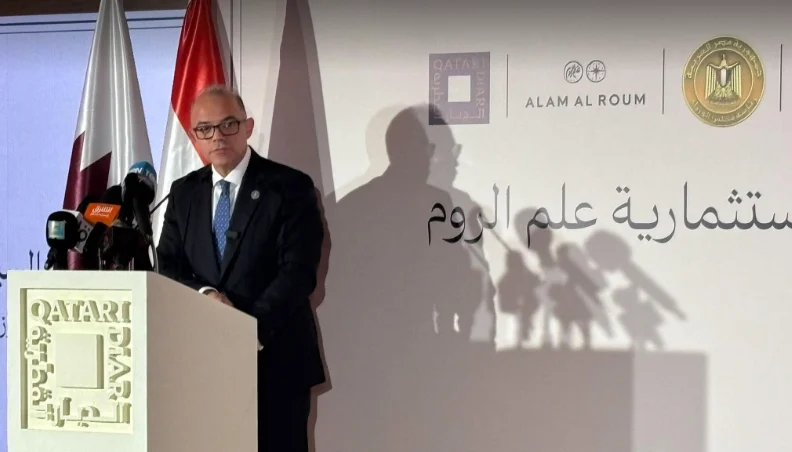
Mohamed Ahmed _ Dr. Mohamed Farid, Minister of Investment and Foreign Trade, emphasized that enhancing the role of the private sector and localizing economic development serve as a fundamental pillar for achieving sustainable growth and job creation, noting that the private sector's share of total investments in Egypt has risen to approximately 65%–67%, compared to previous averages ranging between 40% and 45%.
Private Sector Share of Total Investments in Egypt Rises to Approximately 67%
Farid added that private sector investments exceeded EGP 1 trillion for the first time during the past year, reflecting its growing role in economic activity, explaining that foreign direct investment in Egypt recorded around $15 billion after excluding major investment deals.
During the press conference held to announce the details of the investment zone in the "Almaza Bay / Alam El Roum" project, executed by "Qatari Diar", the Minister stressed the importance of integration among the Ministries of Investment, Housing, Finance, and Industry to streamline procedures for investors and accelerate project implementation.
We Target Raising the Investment Rate to 25% of GDP
Farid pointed out that reaching the targeted economic growth rates of 5.5% to 6.5% requires increasing the investment rate to approximately 25% of the Gross Domestic Product (GDP), noting that the private sector absorbs over 70% of the workforce in Egypt, which underscores the importance of expanding its participation in economic activity.
He explained that Egypt possesses investment fundamentals beyond land availability, encompassing manufacturing and technical capabilities across several sectors, including fertilizers, real estate, and feeder industries such as steel, cement, and ceramics, thereby supporting opportunities to establish new projects and deepen local content.
Dr. Farid affirmed that establishing investment zones is not limited to attracting capital, but aims to localize economic development by providing direct and indirect job opportunities for residents of communities surrounding the projects, particularly in the tourism, real estate, and industrial sectors.
He noted that state investments in infrastructure and the road network contributed to creating the necessary environment for developing investment zones, enhancing their capacity to attract investments, and facilitating accessibility.
Regarding the improvement of the investment climate, the Minister explained that investment zones established pursuant to Investment Law No. 72 of 2017, along with the Golden License regime, provide mechanisms to expedite licensing procedures and minimize bureaucratic obstacles through specialized board and executive councils.
Plan to Launch the Digital "Economic Entities Platform" Within 18 Months
He revealed a plan to launch the digital "Economic Entities Platform" within 18 months, enabling investors to track their applications and licensing procedures digitally across various government entities, contributing to faster transaction processing and improving the efficiency of services provided to the business community.
Dr. Mohamed Farid stressed that the Ministry of Investment and Foreign Trade continues to expand the establishment of public and private investment zones and free zones in cooperation with the Ministry of Housing and relevant jurisdiction authorities, affirming state support for investors and its keenness to provide a stable business environment compliant with the law.
The Minister of Investment welcomed the expansion of "Qatari Diar" investments in the Egyptian market, highlighting the importance of investment partnerships in supporting economic activity, enhancing development opportunities, and generating more job opportunities.