
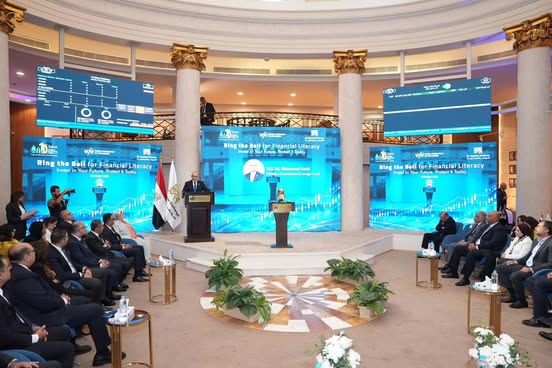
Rana Mamdouh_ The Financial Regulatory Authority (FRA) participated in the "World Investor Writer", the annual periodic event launched by the International Organization of Securities Commissions (IOSCO) to unify international efforts to spread financial literacy, enhance investor protection, and market integrity, which was hosted by the Egyptian Exchange (EGX) at the start of today's trading session.
On behalf of FRA Chairman Dr. Islam Azzam, Dr. Mohamed Abdel Aziz, Assistant Chairman of the FRA, delivered a speech outlining the pillars of the FRA's strategy to spread financial awareness and literacy among citizens, driven by the necessity of enhancing the capacity of individuals and institutions to make sound investment decisions, utilize secure investment channels, and prevent the risks of emerging negative practices in the markets.
This came during the bell-ringing ceremony in the presence of the Minister of Investment, Dr. Mohamed Farid Saleh, EGX Chairman Omar Radwan, Dr. Tarek Seif, Vice Chairman of the FRA, Mr. Mahmoud Gibril and Hamdy Badawy, Assistants to the FRA Chairman, alongside a number of leaders from regulatory and governmental entities and investors.
Building upon the recent awarding of the Nobel Prize in Economics to Robert Hall and Michael Woodford, Dr. Mohamed Abdel Aziz discussed their studies, which established the theoretical and statistical framework of the New Keynesian school. These studies emphasized the necessity of linking the behavior of individuals and corporations to the strength of the economy as a whole, and that citizen awareness and saving and consumption decisions are the actual drivers of the success or failure of states' public policies.
He added that citizen behavior is primarily shaped through surrounding circumstances and financial culture, illustrating that financial awareness is no longer a luxury, but a necessity—not only to maximize individuals' benefits, but fundamentally for the prosperity of the national economy.
We Have Succeeded in Incorporating Financial Literacy into Secondary Education, and Soon Linking Theoretical Study with Practical Application
He explained that the FRA is working to transform the dissemination of financial literacy from fragmented or seasonal awareness efforts into a sustainable institutional capacity-building system that links knowledge with practical application and enhances citizens' ability to safely utilize non-banking financial services and products, through an integrated five-pillar strategy.
Regarding the first pillar concerning educational curricula, he highlighted the cooperation with the Supreme Council of Universities, the Ministry of Higher Education and Scientific Research, and the Ministry of Education and Technical Education, which resulted in the inclusion of a financial literacy curriculum for second-year secondary school students, enabling them to learn about the fundamental concepts of saving, investment, and financial markets.
He explained that the practical aspect aims to provide a learning experience simulating trading in the Egyptian Exchange (EGX) through virtual portfolios, allowing students to practice buying and selling operations and understand market movements, with plans to study actual investment in a later stage to test their ability to apply what they have learned, thereby bridging theoretical knowledge with practical experience.
Dr. Mohamed Abdel Aziz noted that the second pillar—simplifying financial terms and concepts—represents another focal point in the FRA's efforts. This is achieved through the preparation and launch of introductory booklets on non-banking financial activities, explaining services, products, and operating mechanisms in clear language suitable for both specialists and non-specialists. He called on all relevant institutions to facilitate data and figures and bring them closer to general knowledge to help citizens understand the nature of available services, compare alternatives, and recognize their rights and obligations, thus expanding the customer base on the basis of knowledge rather than mere service availability.
The third pillar is linked to the positive impacts of expanding the use of financial technology (FinTech) in providing greater opportunities for access to financial services across various segments of society, particularly youth. Conversely, the need has grown to raise awareness of the risks of digital fraud and data misuse. This leads to the fourth pillar of the strategy, where the FRA is active in implementing awareness campaigns and lectures across governorates and universities to familiarize citizens with the rules of safe handling, monitored investment channels, and how to benefit from non-banking financial activities and maximize their developmental contribution. The latest of these was the conference titled "Capacity Building for Enhancing Development – Know to Benefit" under the auspices of the Prime Minister in Alexandria on Thursday, October 15.
He stressed the importance of public awareness regarding not sharing personal data, login credentials, or verification codes, and ensuring that the entities they deal with hold the necessary licenses from the FRA. These measures are of particular importance given the evolution of digital deception methods, including the impersonation of financial institutions and the use of artificial intelligence technologies to produce misleading content aimed at influencing individuals' decisions.
He noted that spreading financial literacy requires cooperation among regulatory bodies, educational institutions, and market participants to instill regular saving and investment practices, and to help individuals allocate a portion of their income in accordance with their capabilities, financial obligations, and long-term goals.
Gradual Investment Supports the Capacity to Face Economic Risks and Build Long-Term Financial Plans
The fifth pillar involves the gradual transition from saving to investment by changing the citizen's culture and encouraging them to make sound, gradual investment decisions—even if they start small—through secure investment channels instead of negative practices widespread in the markets. In this regard, he explained that holding cash without investing it reduces its purchasing power in the face of inflation, citing the value of gold against the pound: the price of 37 kilograms of gold in 1990 equals only 156 grams today.
It is worth noting that this year's World Investor Week focuses on three main themes: investor resilience by encouraging long-term financial planning and conscious handling of market volatility; digital deception and raising awareness of the risks of misinformation and forgery using modern technologies; and awareness of financial fraud methods and prevention ways.
World Investor Week is an annual initiative organized by the International Organization of Securities Commissions (IOSCO), which includes securities market regulators from around the world. Dr. Islam Azzam currently serves as Vice Chairman of the Board in his capacity as Chair of the Growth and Emerging Markets Committee (GEMC).
The organization works to develop international regulatory standards and practices, and the initiative aims to enhance investors' knowledge of opportunities and risks, instill responsible investment practices, and support their ability to protect their rights and make decisions based on reliable information and a clear understanding of the nature of financial instruments.
Rana
It is worth noting that this year's World Investor Week focuses on three main themes: investor resilience by encouraging long-term financial planning and conscious handling of market volatility; digital deception and raising awareness of the risks of misinformation and forgery using modern technologies; and awareness of financial fraud methods and prevention ways.
World Investor Week is an annual initiative organized by the International Organization of Securities Commissions (IOSCO), which includes securities market regulators from around the world. Dr. Islam Azzam currently serves as Vice Chairman of the Board in his capacity as Chair of the Growth and Emerging Markets Committee (GEMC).
The organization works to develop international regulatory standards and practices, and the initiative aims to enhance investors' knowledge of opportunities and risks, instill responsible investment practices, and support their ability to protect their rights and make decisions based on reliable information and a clear understanding of the nature of financial instruments.