
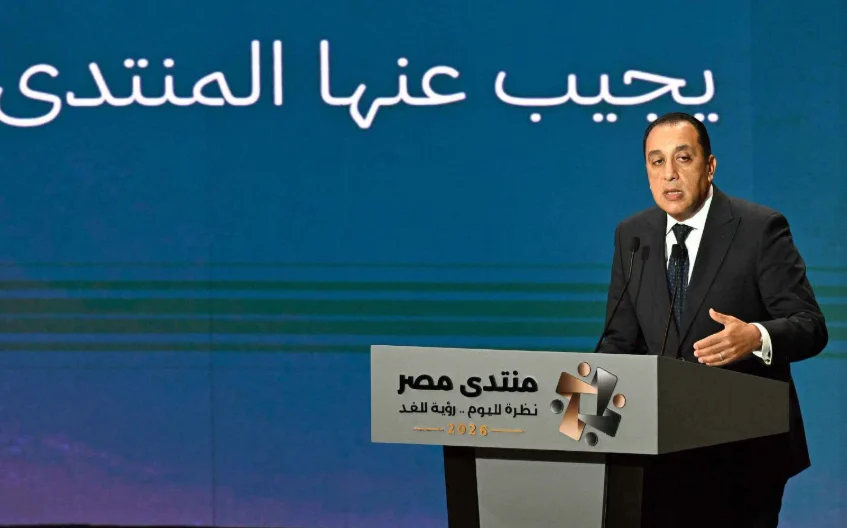
Dr. Mostafa Madbouly, Prime Minister, delivered a speech during the opening session of the “Egypt 2026 Forum,” held under the slogan “A Look at Today .. A Vision for Tomorrow,” in the presence of President Abdel Fattah El-Sisi, President of the Republic.
The Prime Minister pointed out that this forum aims to engage in a serious and constructive dialogue regarding the reality and future of our beloved homeland, Egypt, explaining that the forum presents an opportunity to showcase what has been achieved across various sectors and fields over 12 years of Egypt's journey of construction and development, amidst unprecedented circumstances and challenges that Egypt has faced and that the world has experienced and is currently going through.
The Forum is Not a One-Way Dialogue, But Rather a Two-Way Dialogue
He noted that the forum is not only for showcasing the achievements made within the framework of the construction and development journey—achievements of which many will be presented during the forum's various sessions—explaining that the presentation will take place within the context of listening to and responding to the concerns, criticisms, and proposals of society and citizens. He stated: “The forum is not a one-way dialogue, but rather a two-way dialogue.” Accordingly, the government will not speak alone while citizens merely listen; rather, the opposite is true: “The citizen also speaks, and the government listens.” He indicated that this was reflected in the determination of the themes and sessions of this forum, stating: “The government did not set these themes and sessions alone; rather, a scientific methodology was applied to identify citizens' concerns and priorities.”
Madbouly explained that during the 15 days following the call by President Abdel Fattah El-Sisi, President of the Republic, to hold this forum, opinion polls were conducted involving citizens, youth, investors, and private sector representatives, addressing their vision regarding the most important issues and identifying their needs and level of satisfaction with the services provided to them by the Egyptian state.
The Prime Minister noted that listening sessions for citizens were also held at the headquarters of the National Academy for Training, attended by more than 450 citizens who presented approximately 150 ideas and proposals, amid serious participation from Egyptian universities and think tanks. More than 4,500 academics, researchers, and experts participated in 30 preparatory sessions held across 28 Egyptian universities, including prestigious institutions such as Cairo, Ain Shams, and Alexandria universities, alongside capital, community, and private universities. In addition, about 13 preparatory sessions were organized with the participation of some 16 think tanks represented by numerous public figures and intellectuals inside the Information and Decision Support Center at the Cabinet headquarters, followed by the most important step of launching the forum's website.
More than 61 Thousand People Registered on the Forum's Website, Submitting More than 16 Thousand Ideas and Proposals
Madbouly explained that when the website was established, there was anticipation regarding the level of engagement, noting that up to this moment, the website has witnessed 17 million views, and more than 61,000 people have registered through it, submitting over 16,000 ideas and proposals. Most importantly, 50% of the participants and registrants via the website are in the 18 to 35 age group—meaning we are talking about our youth—including more than 5,000 students, some of whom are school students.
He added that this interaction resulted in gathering more than 42 questions occupying public opinion, which are currently being displayed on the hall screen with a very high degree of diversity. He emphasized that this forum will represent an opportunity for ministers and officials, alongside showcasing what has been achieved in the Egyptian state, to respond to raised questions such as: Why did you build the New Capital? Was the scale of road and bridge projects a necessity, or should the focus have been on health and education? What is the future vision for the Egyptian economy after the International Monetary Fund phase? How will the state move to address the external and regional challenges facing Egypt? And what steps will the state take regarding the debt file? All these questions will find answers during the forum sessions.
Madbouly stressed that the “Egypt 2026 Forum” represents an important opportunity to review the state's implemented efforts and achievements across various sectors, and to answer all citizens' inquiries with complete frankness and transparency without withholding any information. This reflects the state's keenness to keep citizens informed of facts and to clarify the results of policies and measures taken, alongside their tangible outcomes on the ground.
The Importance of Objectively Evaluating the Experience and Assessing What Has Been Achieved So Far
The Prime Minister explained that the forum aims to review various experiences and successes achieved, as well as to discuss the challenges or failures some paths faced, in light of emerging circumstances and variables that sometimes forced a reconsideration of certain orientations and paths. He underscored the importance of objectively evaluating the experience, assessing what has been achieved so far, and considering what conditions might have led to had the necessary measures not been taken, ultimately determining action priorities for the upcoming phase.
Transitioning from Presenting General Visions and Ambitions to Defining Clear Targets and Precise Implementation Plans
Madbouly pointed out that the next phase, extending until 2030, requires transitioning from presenting general visions and ambitions to defining clear targets and precise implementation plans, with a focus on what will be accomplished over the next three years and clarifying the procedures designated to achieve these targets, thereby enabling the evaluation of results and monitoring of implementation rates in a specific manner.
Five Issues Top the Concerns of 70% of Citizens' Opinions, Namely: Education, Prices, Health Services, Wages and Pensions, and Security and Stability
In a related context, the Prime Minister explained that the results of monitoring citizens' opinions and proposals showed that five issues topped the concerns of about 70% of them: education, prices and inflation control, improving health services, wages and pensions, and the continuity of security and stability.
He added that citizens' proposals also reflected an interest in a number of files, including education, culture, media, the enhancement of Egyptian national identity, the labor market, youth and sports, and communications and information technology. He emphasized that youth represent a fundamental pillar for the state's future, which was reflected in the formulation of the forum's themes and the selection of topics open for discussion.
He affirmed that the forum's activities, spanning the coming days, will address a main theme each day, allowing for the comprehensive discussion of priority issues, the review of achieved results, the identification of existing challenges, and the presentation of the state's targets and plans to address them during the upcoming phase.
He pointed out that this forum will belong to the citizen, quoting His Excellency the President of the Republic that the citizen is the “hero of the story,” and that the Egyptian citizen is the one who bore alongside the state every burden of economic reform, structural reforms, difficult conditions, and unprecedented challenges witnessed by the country over the past fifteen years.
At the conclusion of his speech, the Prime Minister quoted an intellectual: “Building any nation is a long and arduous marathon; those who seek quick glory do not succeed in it, and the progress of any state does not depend on those who make promises, but rather on sincere and honest effort exerted by all sons of this homeland.”