
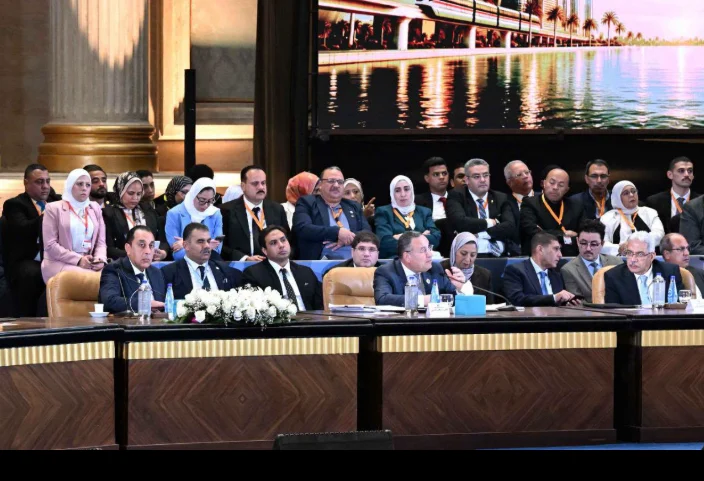
Hapi_ Dr. Mostafa Madbouly, Prime Minister, delivered a speech during a session titled "What Are Our Children Learning… and Does It Qualify Them for the Future?", as part of the activities of the first day of the "Egypt Forum 2026", held under the theme "A Look at Today.. A Vision for Tomorrow", under the auspices of President Abdel Fattah El-Sisi, President of the Republic.
The session was attended by Mohamed Abdel Latif, Minister of Education and Technical Education; Dr. Abdel Aziz Qonsowa, Minister of Higher Education and Scientific Research and Acting Minister of Culture; Dr. Ashraf El-Shihy, Chairman of the Education and Scientific Research Committee in the House of Representatives; a number of university presidents, educational institutions leaders, academics, and experts in the field of education; alongside representatives of the private sector, civil society, as well as students, parents, and youth representatives.
At the beginning of his speech, the Prime Minister welcomed the participants in the session, stressing that the education file represents a top priority for the Egyptian state, stemming from its conviction that the progress of any nation is measured by its level of education, and its ability to graduate a youth capable of keeping pace with the demands of the era.
He explained that the challenge in this file is very significant across all countries of the world, not just in Egypt, noting that there are large and advanced countries facing issues in their education systems, despite not facing the massive challenges that Egypt has faced and continues to face.
He stressed that President Abdel Fattah El-Sisi has placed the education file at the top of the priorities since assuming responsibility, and important steps have been taken, pointing out that many wonder about the reasons for not focusing on health and education and being preoccupied with construction and infrastructure projects.
In this regard, the Prime Minister mentioned that tackling the education file was a challenge, as the number of students per classroom previously ranged between 100 to 120 or 150 students, which hindered achieving tangible results for any development process, questioning what kind of education these students could receive under such conditions.
He also pointed out that global standards dictate having one university for every million citizens, whereas the number of universities in Egypt was only around 50 in 2014, while it has currently risen to about 131 universities, with the population reaching 110 million, explaining that Egypt has thus begun to exceed global averages relative to population size.
He affirmed that infrastructure development must proceed in parallel with improving the quality of education, adding that it was impossible to develop curricula amidst the problem of teacher shortages, alongside the lack of teacher qualification to teach the new curricula.
He explained that the process of developing education takes a long time and requires cumulative effort, and these problems cannot be solved overnight, as accumulated issues dating back decades are currently being addressed.
Dr. Mostafa Madbouly emphasized that the state has made great strides in solving root problems in the education file, noting that the focus during the coming period will be placed on the quality of the educational system, aiming to graduate youth capable of keeping pace with the requirements of the modern and fast-paced era, pointing out his keenness to answer numerous questions regarding the education file during his speech.
Dr. Mostafa Madbouly explained that, as the Minister of Education and Technical Education clarified, the implementation of the Baccalaureate system came in response to the need to achieve equality among students, noting that prior to applying the Baccalaureate program in public schools, private and international schools were applying international educational systems such as IG and the American system, offering students second and third opportunities to improve their scores, whereas a student in public schools and traditional Thanawiya Amma had only one opportunity in their life.
The Prime Minister questioned: "God forbid, if our child faces a circumstance, illness, or accident, and is unable to perform well in the exam, what is the result?", pointing out that he feels great pain every year when reading news of a male or female student committing suicide due to lack of success in Thanawiya Amma, which has come to be viewed as if it were the end of life.
Madbouly affirmed his awareness of the magnitude of psychological and nervous pressure placed on the Egyptian family and their children, explaining that the new system has equalized students in public schools with their peers in private schools.
He added that this was one of the reasons for the necessity of curriculum development, given the rapid acceleration in the development of science curricula, explaining that previously, curricula could remain unchanged for 10, 15, or 20 years, whereas today, every day brings something new.
He noted that failing to continuously update curricula constitutes an injustice to students, as they might learn outdated information prior to joining the labor market, stressing the necessity of reviewing curricula every 3 or 4 years to determine the need for their development, and that the coming phase will witness a focus on the quality of education.
Dr. Mostafa Madbouly explained that the coming phase also aims to continue developing the education system in its various components, including educational projects, institutes, and teachers, emphasizing the importance of development efforts being tangibly reflected on the ground, and that educational policies respond to issues that concern citizens and address the challenges they face.
Dr. Mostafa Madbouly also pointed out that a number of demands and complaints he heard from citizens during his field tours pertained to the status of Arabic Language and Religious Education subjects in international schools and counting their grades within the total GPA, explaining that these complaints reflect fears among some parents regarding their children.
In this context, he stressed that the issue is not limited to the regulatory aspects of the educational process, but extends to the importance of preserving Egyptian national identity and Egyptian national security, questioning the extent of knowledge students studying in these schools have regarding the Arabic language, as it is the national language and the language of Egyptian society, warning that the decline of interest in it represents a challenge that must be dealt with seriously, given the potential repercussions affecting national identity and Egyptian national security.
Dr. Mostafa Madbouly underscored the importance of state intervention to address this issue, ensuring the protection of youth, strengthening their connection to their language and national culture, and instilling Egyptian identity in new generations, while achieving a balance between openness to international educational systems and preserving national fundamentals.
In a related context, the Prime Minister touched upon one of the issues raised by citizens regarding the higher education system, related to the admission of international students to Egyptian universities, and the resulting questions regarding the admission opportunities for Egyptian students in high-demand faculties, foremost among which are faculties of medicine.
He explained that some parents question the fairness of providing admission opportunities for foreign students at a time when the scores of some Egyptian students, despite being high, do not allow them to join these faculties, emphasizing the importance of clarifying the foundations regulating this system to public opinion.
In this framework, Dr. Mostafa Madbouly pointed to what was explained by the Minister of Higher Education and Scientific Research regarding the state's keenness to enhance the international standing of Egyptian universities and improve their global rankings, noting that attracting international students represents one of the elements linked to the presence of universities in international rankings, according to the standards adopted in this regard.
He stressed that the presence of international students in Egyptian universities contributes to enhancing their international academic standing and supports their ability to compete regionally and globally, reflecting positively on the value of the degrees they grant and their standing in labor markets outside Egypt.
The Prime Minister gave an example of the German University in Cairo (GUC), as one of the universities that enjoys a presence in international rankings, explaining that enhancing international recognition of Egyptian universities and their qualifications requires dealing with ranking criteria as part of an integrated system for higher education development.
He emphasized the importance of understanding the dimensions of this issue when discussing rules for international student admissions, while taking into account the necessity of balancing between enhancing the international competitiveness of Egyptian universities and preserving opportunities for Egyptian students to enroll in various faculties.
Dr. Mostafa Madbouly, Prime Minister, also affirmed that education represents one of the main pillars of Egyptian soft power, stressing the importance of developing Egyptian universities, explaining that the importance of attracting international students is not limited to educational aspects, but extends to strengthening Egypt's relations with other countries, by preparing graduates who are culturally and humanely attached to Egyptian society, carrying positive experiences from their period of study and residency in Egypt.
Dr. Mostafa Madbouly noted that a number of graduates from Egyptian universities may assume leadership positions in their countries, whether as heads of state, governments, or ministerial positions, which reflects the importance of the role education plays in building long-lasting relations between Egypt and various countries worldwide.
He added that an Egyptian university graduate assuming a leadership position in his country would enhance rapprochement with Egypt, given that years of study and living within Egyptian society contribute to forming positive bonds and relationships that persist after the completion of the educational stage.
Madbouly concluded by emphasizing that education is one of the main components of state soft power, and that enhancing the capability of Egyptian educational institutions to attract foreign students contributes to supporting Egyptian international presence.