
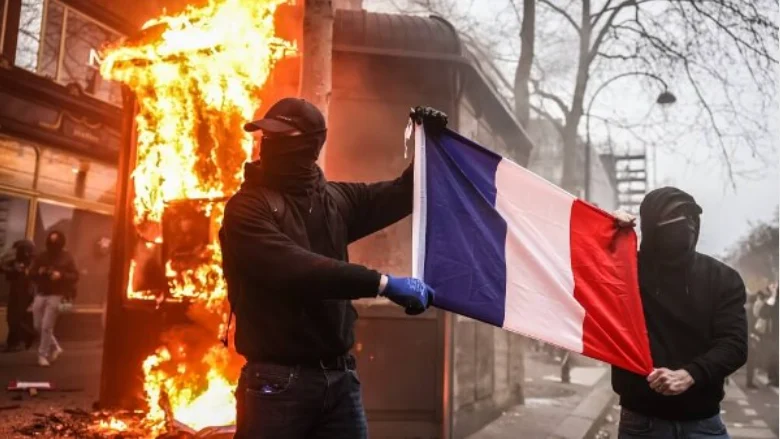
Samar El-Sayed _ Violent protests and widespread demonstrations are currently shaking the Old Continent amid economic and social crises, including high living conditions, soaring inflation rates, rising rental prices, poor university conditions, and increased tuition fees.
These countries include France, Italy, Albania, Portugal, Spain, and Belgium.
Implications for European Stock Markets
European stock markets were not immune to these successive developments, opening trading today, Monday, lower following a weekend that witnessed some of the most violent protests in years in France, amidst efforts by store owners and corporate CEOs to assess the extent of the damage, while accusing French authorities of leaving them exposed to danger.
A report published on the Euronews website indicates that the Euro Stoxx 50 index dropped by only 0.1%, while the broader European Stoxx 600 index fell by more than 0.6% at the start of today's session.
In the same context, the French CAC 40 index dropped by 0.5%, and Carrefour retail shares declined by more than 2% after announcing that 50 of its stores were targeted by looters.
Regarding other European indices, the British FTSE 100, Italian FTSE MIB, and Spanish IBEX 35 indices declined by percentages ranging between 0.4% and 0.6% compared to their stock exchanges' close last Friday.
The German DAX index led the decline, dropping by more than 0.8%, while the Dutch AEX index was the sole exception, trading higher by more than 0.4%.
This comes as Moody’s credit rating agency moved to evaluate France's Aa3 sovereign credit rating with a negative outlook.
The euro exchange rate fell by 0.2% against the US dollar to reach approximately 1.121 dollars, and also declined by 0.2% against the British pound to reach about 0.841 pounds.
The Euronews report indicates that the euro's exchange rate against the dollar dropped to its lowest levels since mid-May 2025, and against the British pound since early June 2025, in light of the impact of French debt problems and dollar strength on two interest rate hikes carried out by the European Central Bank this year.
Protests in France
French authorities reported that about 550,000 people participated in marches last Saturday to protest the high cost of living and conditions in French schools, which turned into riots and looting in the cities of Paris, Lyon, Marseille, Bordeaux, and others.
Interior Minister Laurent Nuñez stated that 2,400 people were detained, while the number of injured among police officers and firefighters is estimated to be between approximately 500 and 1,000.
Euronews reported that Nuñez offered his resignation after admitting a lack of proactivity and loss of control over the protests in some cities, but President Emmanuel Macron rejected the resignation on the grounds that security forces need uninterrupted, continuous leadership.
In a related context, Alexandre Bompard, Chairman of Carrefour and head of the French Retail Federation, stated that about 1,500 stores were attacked, resulting in losses amounting to hundreds of millions of euros, adding that for his company alone, the cost of repairs will far exceed 10 million euros.
At the same time, President Macron instructed the Interior Minister to take all necessary measures to ensure full transparency regarding the planning and intelligence failures that led to this violence in his country.
The Interior Minister announced that a set of measures will be imposed to contain and prevent looters and vandals, starting Monday evening, while reinforcing the deployment of police forces on the ground.
It is worth noting that Sunday evening witnessed groups taking to the streets once again to set fire to garbage dumpsters, bicycles, and property, and to loot stores in cities including Paris, Lyon, and Marseille.
Clashes in Belgium
Police and protesters clashed in Brussels last Friday, coinciding with tens of thousands marching against the high cost of living and government financial austerity measures.
Hundreds of youths confronted riot police in the streets of Brussels, with police deploying water cannons and tear gas, according to Euronews.
About 30,000 people participated in the strike against austerity measures, and tensions escalated following a week of student protests inspired by the French protests.
Euronews reported that masked youths threw rocks and fireworks at police at Brussels Central Station and set bicycles on fire.
Unrest in Italy
Italian Prime Minister Giorgia Meloni called for a security meeting today, Monday, to counter the acts of violence that mirrored scenes of chaos and looting in Paris.
Youths and police clashed for a second day in the city of Milan yesterday, Sunday, as attackers hurled bottles, looted shops, and destroyed property around the Duomo square.
Milan police have arrested more than 200 people since last Saturday, according to Euronews and the Ansa news agency.
It is worth noting that the Milan clashes erupted last Saturday on the sidelines of a demonstration against the high cost of living, and the cities of Bologna and Turin also witnessed similar unrest.
Protests in Albania
The recent unrest in Albania came after months of anti-government protests, which initially broke out due to a controversial resort project in an ecologically protected area linked to US President Donald Trump's family.
Albanian police deployed water cannons and tear gas yesterday, Sunday, as anti-government protests entered their sixth day, and Prime Minister Edi Rama rejected protesters' demands to resign, according to Euronews.
It is noteworthy that violent protests have shaken the Albanian capital, Tirana, since last Tuesday due to poor university conditions, high tuition fees, and corruption. Protesters set fire to garbage containers, smashed windows—including those of the ruling Socialist Party headquarters—and set fire to a police station and the entrance of the Ministry of Interior.
The Ministry of Health reported that 16 police officers were injured, 14 of them during the attack on the police station, according to the French AFP agency.
The Situation in Spain
Spain is also witnessing widespread protests and demonstrations over housing costs and forced evictions since late September, according to a report by Sky News Arabia and the German News Agency.
}