
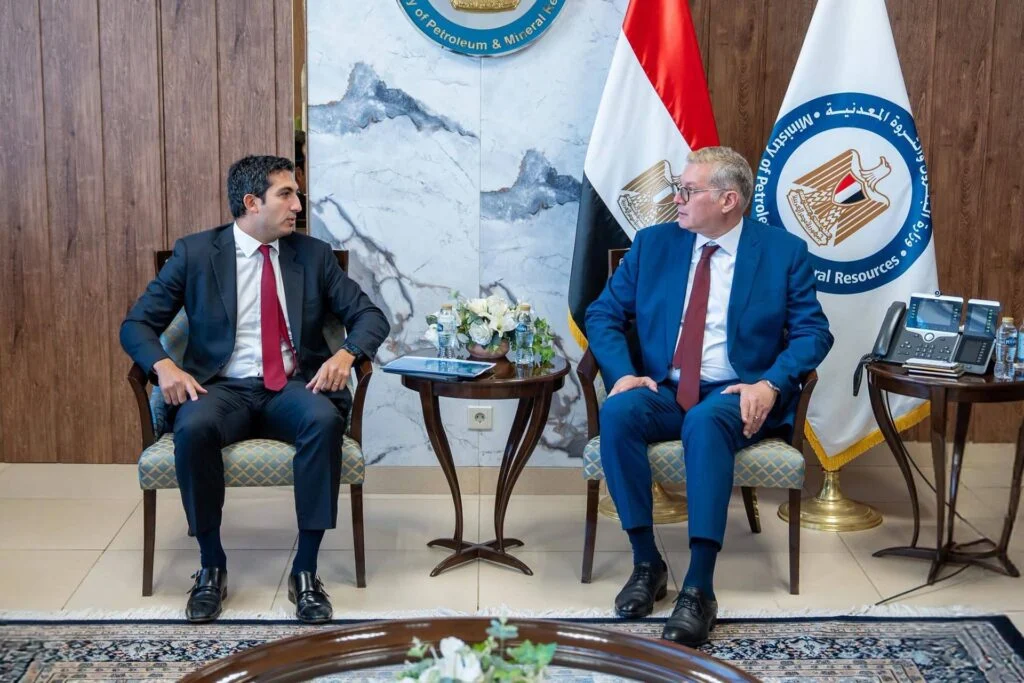
The endeavors to process more of Egypt's phosphate locally and convert it into fertilizers have attracted another major entity, as the fertilizer producer Fertiglobe, controlled by the UAE’s ADNOC, is studying the establishment of a complex worth over USD 1.5 billion in Ain Sokhna to produce di-ammonium phosphate (DAP), according to a statement issued by the Ministry of Petroleum following a meeting between Minister of Petroleum Karim Badawi and Ahmed El-Hoshy, CEO of Fertiglobe.
The plant will produce 1.3 million tons annually of di-ammonium phosphate, one of the most widely used fertilizers globally, manufactured through the reaction of phosphoric acid with ammonia. The company aims to commence commercial production in 2031, subject to the results of feasibility studies which El-Hoshy stated are currently underway in cooperation with consultants, and securing long-term supplies of local phosphate ore, which he described as a fundamental factor for completing the evaluation. Fertiglobe is also studying producing phosphoric acid itself and converting it into final fertilizers at the same site, leveraging Egypt's ammonia supplies and its existing industrial base, according to the statement.
Sokhna is not unfamiliar territory for Fertiglobe, as the company already operates two plants there: the Egyptian Basic Industries Corporation (EBIC), which produces ammonia—one of three raw materials required for the DAP plant—and Egypt Fertilizers Company (EFC), which produces urea and Diesel Exhaust Fluid (DEF), commercially known as AdBlue. Both units achieved record performance in the first quarter of 2026, with EFC operating at over 105% of its capacity.
Part of a broader trend
Fertiglobe will join a growing list, as the government seeks to attract investors to process phosphate locally and direct it toward "high-yield industries rather than exporting it as raw ore," according to the Ministry of Petroleum upon signing the contracts for the USD 658 million Abu Tartour phosphoric acid complex in 2025. Several major projects are already moving forward:
- Abu Tartour, New Valley: Construction work began on the USD 658 million complex last August, which will produce 250,000 tons annually of phosphoric acid for export via Safaga Port. State-owned Al-Nasr Company for Phosphate (El-Wadi El-Gadid for Mineral Resources and Clays [WADICO]) holds a 25% stake, while China State Construction Engineering Corporation (CSCEC) and East China Engineering Science and Technology Co., Ltd. (ECEC) are undertaking its construction over 30 months.
- Indorama, Ain Sokhna: A USD 525 million complex in partnership with Egypt Phosphate (15%) will produce 600,000 tons annually of DAP and mono-ammonium phosphate (MAP), another phosphate fertilizer, with 80% of production directed for export. Indorama is nearing the acquisition of USD 348 million in financing from the International Finance Corporation (IFC) and the European Bank for Reconstruction and Development (EBRD) for the project.
- Sokhna 360: Initially announced as a USD 1 billion phosphate complex in partnership with China’s CJN, it has now become a joint venture between the Egyptian Mineral Resources Authority (EMRA), WADICO, and El Sewedy Electric. The first phase is designed to produce 300,000 tons annually each of phosphoric acid, DAP, and triple superphosphate (TSP).
- Xingfa and the Golden Triangle: The Chinese company, the world’s largest producer of specialty phosphorus chemicals, plans to establish a USD 2 billion integrated complex in the Golden Triangle Economic Zone on the Red Sea coast. The complex will be implemented in three phases, starting from phosphate extraction up to the production of higher-value chemicals for the electronics, food, and pharmaceutical industries. It will be Xingfa’s largest project outside China, though it has not yet announced its production capacity or timeline.
- Asia Potash in Upper Egypt: The Chinese company has floated the idea of establishing a complex costing up to USD 10 billion across all its phases, including USD 1.6 billion for the first phase, with total production directed for export. The company has so far only signed a memorandum of understanding in July 2025.
Driven by its production capacity of 1.3 million tons annually, Fertiglobe’s plant will be larger than any project announced in Sokhna to date, according to our calculations. Raw material is not expected to pose a problem, as Egypt possesses approximately 2.8 billion tons of phosphate reserves and extracted around 5.5 million tons last year, according to the US Geological Survey (PDF).
The Economic Feasibility Equation
The success of the plant depends on achieving a balance among three raw materials: phosphate, sulfur, and ammonia, according to Raed Al-Saoub, former Secretary-General of the Arab Fertilizer Association (AFA), speaking to Enterprise Morning. He explained that "phosphate concentration and processability" determine the cost base. Meanwhile, sulfur—which is burned to produce sulfuric acid necessary for converting the ore into phosphoric acid—represents the material most vulnerable to market risks and fluctuations. Al-Saoub added that a plant of this scale will require about 500,000 tons of sulfur annually under the traditional method, exposing it to price volatility.
Egypt enjoys a competitive advantage due to the availability of ammonia, according to Al-Saoub, noting that Fertiglobe already produces it at the EBIC facility located nearby. Al-Saoub questioned: "The challenge lies in the economic calculus: Will converting ammonia into DAP yield a greater return for the company and the economy than selling and exporting it directly?" He added that the management of phosphogypsum—the primary byproduct of phosphate processing—along with water consumption and emissions, will also impact investment and operational costs from day one.
Less Vulnerable to Gas Supply Reductions
There is also a strategic advantage, as gas serves as the feedstock for ammonia production, accounting for around 70% of the production cost of nitrogenous fertilizers such as urea. Consequently, ammonia and urea producers are severely impacted by increases in gas prices and reductions in its supply. Conversely, the DAP production line faces lower risks, as ammonia is its only gas-based input, representing a smaller share of its costs, which depend more heavily on phosphate ore and sulfur. This makes the production of phosphate fertilizers in Egypt relatively less costly even if gas prices rise or supplies decline.
Next steps: Fertiglobe will work with the Mineral Resources Authority and mining authorities to identify ore sources and evaluate long-term supplies. Both parties also agreed to accelerate the exchange of technical, geological, and commercial data and prepare for ore supply agreements. Furthermore, Fertiglobe offered to produce AdBlue from Egyptian urea, building upon the diesel exhaust fluid it already produces at EFC, and Badawi requested a technical and economic evaluation before determining the next steps.