
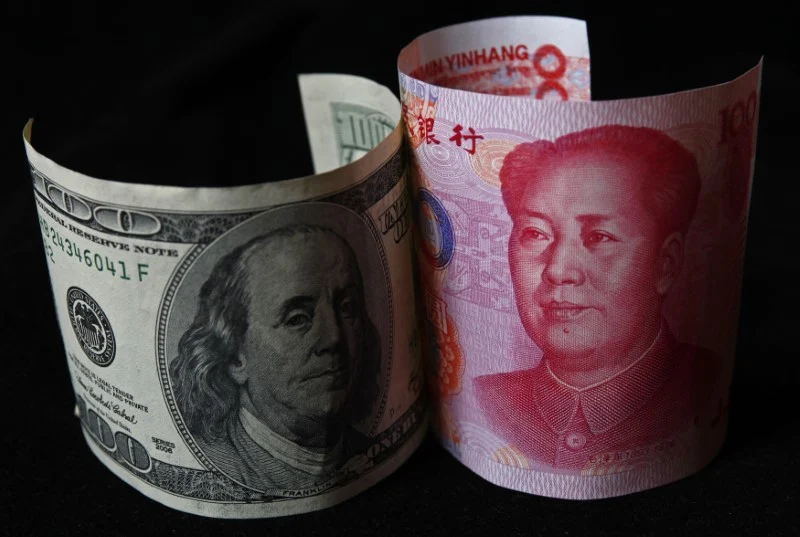
Bloomberg _ Most Asian currencies rose on Tuesday, with the Chinese Yuan hitting a four-year high following a strong daily fixing by the People's Bank of China, amid the decline of the US dollar and signs of recovering investor confidence.
Political risks remained in focus as France imposed curfews in a number of cities following the escalation of anti-government protests that have placed increasing pressure on President Emmanuel Macron in the final months of his term, while Italy announced the deployment of 500 troops following two days of riots.
The USD/CNH pair for the Chinese Yuan fell to an intraday low of 6.6775 against the dollar, its strongest level since July 2022, before stabilizing at 6.6781. The Yuan also rose in the onshore market to 6.6791 against the dollar.
This upward wave came on the heels of a strong daily exchange rate fixing by the People's Bank of China alongside better-than-expected economic data, as the Chinese economy grew by 4.5% year-on-year in the third quarter, and retail sales accelerated in September.
China Keeps Key Loan Interest Rates Unchanged
The improved growth outlook helped ease pressure on Beijing to take bolder stimulus measures, while the People's Bank of China kept its benchmark lending rates unchanged as expected, at 3.00% for the one-year loan prime rate and 3.50% for the five-year rate.
The US Dollar Index fell 0.2% to 101.78, retreating from a part of Monday's 0.2% gains that had pushed it to 101.98 and ended a two-session losing streak.
The EUR/USD pair rose 0.2% to 1.1233, while the GBP/USD pair climbed 0.20% to 1.3333.
Indonesian Rupiah Remains Fragile Following MSCI Reclassification Warning
The Indonesian Rupiah partially recovered on Tuesday, with the USD/IDR pair falling 0.1% to 17,995.70, though the currency remained close to the 18,000 Rupiah per dollar mark, following a sharp sell-off triggered by concerns over Indonesia's standing in global equity indices.
The Rupiah had dropped 0.6% to 18,070 against the dollar on October 16, hitting its weakest level since late July, after index provider MSCI proposed consultations on reclassifying Indonesia from emerging market status to standalone market status.
This warning sparked a fierce sell-off in Indonesian stock markets, with the Jakarta Composite Index plunging nearly 12% on Friday, then continuing its decline on Monday, causing the index to incur losses exceeding 15% over the two sessions.
The index rebounded by about 3% on Tuesday after authorities took measures to curb volatility and pledged further reforms. The two-day crash wiped out about $82,000,000,000 in market value, while the Rupiah has lost about 8% of its value against the dollar since the beginning of the year.
Indian Central Bank Tightens Oversight on Outbound Investments Amid Continuing Pressures on the Rupiah
The Indian Rupee settled at near-flat levels, with the USD/INR pair rising 0.01% to 94.930, as the Reserve Bank of India tightened its oversight on large outbound investments amid persistent pressures on the currency.
Last week, the Reserve Bank of India issued a unified checklist for major banks, requesting detailed information on direct outbound investments exceeding $1,000,000,000, and transactions exceeding the regulatory limit set at four times the net worth of the investing company, according to The Economic Times, citing two sources familiar with the matter.