
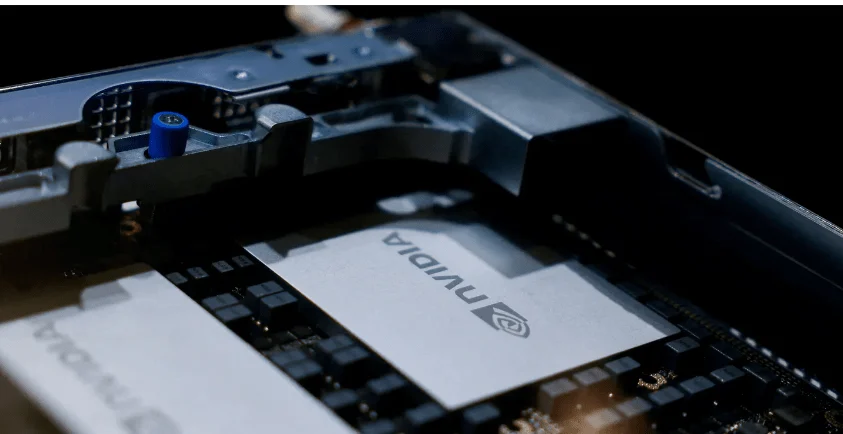
CNBC — Chinese companies ByteDance, Alibaba, and Tencent have ordered more than 3 million units of Nvidia's new "RTX Pro 5500" graphics cards, with a total value exceeding $35 billion. This comes as Chinese firms race to acquire less powerful chips that nevertheless comply with U.S. export controls imposed on trade with China, according to two sources familiar with the matter who spoke to Reuters.
U.S. chipmaker Nvidia has informed its clients and partners that it cannot guarantee the fulfillment of these orders, given that the demand from Chinese technology companies far exceeds planned production volumes, according to the two sources and a third person familiar with the matter.
The "RTX Pro 5500" is a workstation-specific chip designed for high-performance professional computers, rather than the massive data center clusters that utilize Nvidia's more advanced artificial intelligence processors. However, it remains one of the company's most powerful chips still available to buyers in China.
The data center-focused "B300" chip, built on the Blackwell architecture, is not permitted for sale to Chinese buyers under U.S. export controls, while exports of the "H200" chip, built on the Hopper architecture, are subject to case-by-case review and require licenses.
One of the sources stated that Nvidia has informed its partners they may only receive 5% to 10% of the quantities they requested.
Another source added that the company indicated it would be able to produce no more than 3 million units of the "RTX Pro 5500" globally during 2027. Total orders received from customers in China have exceeded 6 million units, according to two sources.
The sources explained that the orders from the three Chinese technology companies involve cards priced at approximately $11,400 each, raising their potential total value to over $35 billion.
The scale of these previously unannounced orders reveals the sustained robust demand from Chinese firms for Nvidia's products, despite U.S. restrictions.
Nvidia CEO Jensen Huang stated that the restrictions have reduced the company's market share in China's AI data center chip market from near monopoly to close to zero. Nevertheless, demand for the "RTX Pro 5500" indicates that the company still possesses a significant potential market in China through less powerful products that remain accessible to buyers there.
The surge in demand also highlights the extent to which U.S. restrictions have impacted computing power supplies within the world's second-largest economy, at a time when Chinese companies are racing against time to develop advanced AI models and support Beijing's efforts to expand the use of this technology across various industrial sectors.
U.S. restrictions have pushed Chinese companies to turn toward domestic suppliers, while Beijing has encouraged the use of locally manufactured chips.
Huawei, in particular, has made market share gains, although Chinese chipmakers have faced general difficulties in keeping pace with leading U.S. products, partly due to separate restrictions limiting their access to foreign equipment used to manufacture the most advanced semiconductors.
An Nvidia spokesperson stated that Chinese manufacturers of workstation chips and cards have experienced "unprecedented growth since 2022," when the restrictions were first imposed.
The spokesperson added that U.S. companies continue to face constraints stemming from a combination of U.S. export controls—which he described as outdated, encompassing gaming products launched approximately five years ago—alongside Chinese restrictions on U.S. imports.
The "RTX Pro 5500" is less powerful than Nvidia's "H200" and "B300" chips, which are designed to operate within large clusters to meet the training and inference demands of AI models at the highest performance levels.
Three sources stated that Chinese companies primarily seek to use these cards for AI inference—running trained models to generate responses for chatbots. Inference operations generally require less computing power than training models on massive datasets.
The "RTX Pro 5500" is similar in performance to the "RTX 6000D" chip, according to product technical specifications reviewed by Reuters.
Nvidia launched the "RTX 6000D" in the middle of last year as a capability-limited product designed to comply with U.S. export restrictions. However, major Chinese technology companies initially showed limited interest in it, with some refusing to place orders, as Reuters reported last year.
At the time, buyers viewed the chip's pricing as high relative to its capabilities, expressing hope that Washington would eventually permit the sale of more powerful Nvidia processors.
However, these expectations diminished as restrictions persisted and AI computing capacity remained scarce, making the "RTX Pro 5500" a more attractive alternative, according to two sources.
Nvidia's inability to guarantee the delivery of full requested quantities reflects both the massive surge in demand and the company's manufacturing priorities, according to two sources.
Beginning in 2027, Nvidia is expected to allocate a significant portion of its production capacity at Taiwan Semiconductor Manufacturing Company (TSMC) to the next-generation "Rubin" platform designed for large-scale data centers, rather than products like the "RTX Pro 5500," according to the sources. TSMC declined to comment.
The sources added that the U.S. company informed clients that initial samples would become available in December, with commercial deliveries commencing during the first quarter of 2027.
One source noted that production of the "RTX 6000D" has since ceased, while its price in the Chinese market has doubled.
In an October 13 filing, Tanson Technology, a fintech and AI computing services provider listed on the Shenzhen Stock Exchange, announced its agreement to purchase 20,000 units of the "RTX Pro 5500" from an undisclosed party.
The company warned that supply shortages, industry demand, and external technology controls could lead to delivery delays or reductions in available quantities.