
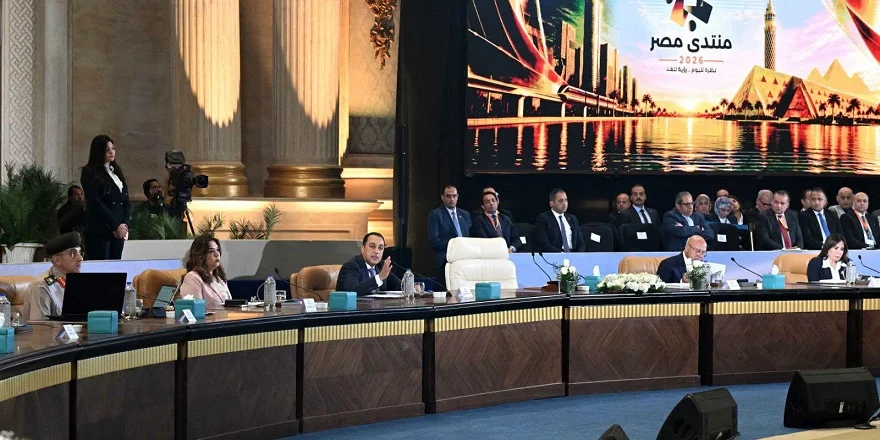
Dr. Moustafa Madbouly, Prime Minister, stressed that 15 million Egyptians currently reside permanently in existing new cities, according to recharged electricity meter data. In addition to 3.3 million meters, there are over 350,000 commercial, industrial, administrative, and other meters, which means that the actual resident population in new cities ranges between 14 to 15 million inhabitants, alongside daily commuters working there.
During a session titled "Urban Development and Construction" at the opening of the second day of "Egypt Forum 2026", Madbouly emphasized that new cities are not empty. The population of New Cairo is approaching 3 million, and 6th of October has reached 2 million, stating: "New cities have become million-inhabitant cities."
He noted that based on this, it became imperative to plan for the execution of additional new cities, known as fourth-generation cities, as cities built since 2014 represented the first three generations according to their timelines.
He added: When city construction began in the 1980s, we benefited from it today. Today, we are working on building new cities that future generations will benefit from by providing a decent environment for incoming youth, pointing to the inevitable necessity of doubling Egypt's inhabited area.
At the beginning of the session, the Prime Minister Cabinet head noted that he would begin the dialogue by addressing and clarifying the numerous questions and concerns raised in this regard, starting with why the state allocated such a large volume of spending to national projects in recent years, particularly in construction, building, and transportation, and what its economic and social returns are for the Egyptian citizen. Was the implementation of all projects appropriately timed? Could some have been executed while postponing others amidst economic challenges? Did the state's focus on building new cities come at the expense of improving services in existing ones? And how does the state guarantee achieving development programs across all governorates and major cities?
In answering these questions and concerns, the Prime Minister attributed the construction of new cities to what successive generations know about this issue, which constitutes one of the state's most critical core problems and challenges: urban concentration (the inhabited area) on an extremely limited portion of Egypt's land mass from the ancient Egyptians up to the 21st century. He noted that at the beginning of the 20th century, Egypt's population was less than 10 million on this same area, then reached around 18 million with the dawn of the July 23, 1952 Revolution, and currently stands at 110 million, leaving attendees to imagine the situation if the inhabited area remained unchanged while the population increased to this extent.
In the same context, Madbouly added: From the 1970s and 1980s up to 2010 and 2011, we witnessed a massive growth in informal settlements, rapid erosion of agricultural land, deterioration of services, and Egyptian cities recording some of the highest population density rates globally. That was the state of Egypt's inhabited area, asking: Did the state not try to address this before? Were there no thinkers and experts discussing this matter?
He pointed out in this regard historian Dr. Gamal Hemdan in his book "The Character of Egypt", as well as numerous historians indicating that Egypt's only solution is to expand beyond the Nile Valley and Delta and inhabit the desert, with no alternative path. He noted that early attempts began with several initiatives by the state, the first being by the late leader President Mohamed Anwar El-Sadat in the late 1970s when he introduced the concept of constructing new cities. At that time, the matter was presented to the Egyptian People's Assembly and faced significant criticism against building new cities, arguing that if existing cities lacked water, sewage networks, roads, and infrastructure, why abandon them to build new cities in the desert when financial resources should primarily be directed toward these urgent needs.
22 New Cities Were Built Up to 2014
He added: We thank God that the late President Anwar El-Sadat persisted in his vision for the Egyptian state and executed these cities. Up to 2014, 22 new cities were established, including: 10th of Ramadan, Sadat City, 6th of October, El Obour, El Shorouk, New Cairo, and others.
Regarding the new cities dossier, the Prime Minister emphasized that the concept of establishing new cities was inevitable. However, the philosophy of President Abdel Fattah El-Sisi since assuming office has been that nothing should be implemented except on a scientific basis. The state does not execute projects randomly; hence, the starting point was a master plan prepared over years, which began before the 2011 revolution and was completed in early 2012, titled "The National Urban Development Plan for Egypt up to 2052," setting a vision for the Egyptian state for the next 40 years.
In this framework, Dr. Madbouly explained that the President had thoroughly studied this dossier before taking office and decided to execute what was set forth in this plan, which was prepared by Egyptian experts and minds, addressing integrated development. He clarified that this master plan was comprehensive and essential because the state urgently required development work over many years, which caused all the problems and challenges previously faced by Egypt, its cities, and its villages.
The New Master Plan Includes 39 New Cities.. 27 of Which Have Been or Are Currently Being Executed
The Prime Minister added that the new master plan includes 39 new cities, 27 of which have already been executed or are under construction, with the remaining 12 cities to be implemented in the coming period. Existing cities currently include: West Qena, Nasser City West of Assiut, New Aswan, East Port Said, New Rafah, New Ismailia, New Mansoura, and many others, emphasizing that the matter is not limited to the New Capital and New Alamein alone. Addressing claims that new cities remain uninhabited, questioning why additional cities are being built,
In response to queries regarding why the New Capital was built, the Prime Minister noted that it is a city like any newly established city, with the difference being the relocation of ministries and the seat of government to it. He added that moving the government from one location to another has occurred throughout human history, explaining that the Downtown area in Cairo—including Tahrir Square and old ministry headquarters—served as a new capital for Egypt established by Khedive Ismail in the second half of the 19th century when the seat of government was at the Citadel of Saladin. The move took place within the framework of modernizing the Egyptian state, as it was deemed unsuitable for the seat of power to remain at the Citadel, leading to the planning and execution of the "Downtown" area as a hub for ministries and authorities for nearly 150 years. He pointed out in this context the number of planners, thinkers, and experts who, since the 1990s, advocated the necessity and inevitability of relocating ministries out of central Cairo due to congestion.
The Prime Minister continued detailing the historical and planning background for selecting the location of the New Capital, explaining that relocating ministries to a new site underwent extensive studies and discussions involving experts and urban planning specialists to determine the most suitable location in light of state needs and future development requirements.
He said: During 2007 and 2008, under former Prime Minister Dr. Ahmed Nazif, instructions were issued to study potential alternatives for moving ministries outside Cairo. The General Authority for Urban Planning under the Ministry of Housing was tasked with proposing alternatives and selecting the most suitable site enabling the state to execute the project.
He noted that a panel of experts, planners, and geographers studied the proposed sites and identified five primary alternatives, including the current location of the New Capital, another area around the Ring Road encompassing the Field Marshal Tantawy Mosque and its surroundings, Warraq Island, an area north of the Cairo-Alexandria Desert Road, and another new city. However, the experts who conducted these studies independently from the government ranked the five alternatives based on suitability, concluding that the current site of the New Capital represented the optimal choice considering future urban expansion opportunities.
Relocating Ministries to the Current Location of the New Capital Acts as a Driver and Catalyst for Accelerating Urban Growth Eastward
He stressed that relocating ministries to the current New Capital location acts as a driver and catalyst for accelerating urban growth eastward, noting that Cairo's urban expansion throughout history has naturally moved eastward.
Regarding the second alternative, the Prime Minister explained that it was the area surrounding the Field Marshal Tantawy Mosque, noting that experts viewed it as suitable location-wise, but anticipated urban growth and traffic congestion over time would cause recurring existing problems, making it less suitable than the first choice. Comparisons among other alternatives considered planning considerations, urban factors, and implementation capabilities.
The Prime Minister clarified that at the time, although the current site of the New Capital was favored from a planning perspective, project execution required massive financial investments amidst limited available resources, prompting consideration of other alternatives from an execution capacity standpoint. Experts agreed that the first location remained best for Egypt's long-term future, especially regarding state needs over the next 50 to 100 years, adding that like many mega projects, execution could not begin under pre-2011 conditions.
The Prime Minister addressed the re-introduction phase of the project, explaining that when presented to President Abdel Fattah El-Sisi, he inquired about study findings and planner opinions regarding the optimal site. When it became clear that the first alternative was most suitable, he instructed proceeding according to that choice based on scientific and planning studies.
Selecting the Site for the New Capital Was Based on Specialized Studies Favoring the Current Location
Dr. Moustafa Madbouly emphasized that site selection was not random, but based on specialized studies favoring the current location in line with the Egyptian state's needs and future urban directions.
In this context, the Prime Minister explained that Cairo was already suffering from severe urban and traffic congestion, stressing that the need to address these challenges existed for decades and that project execution represented a priority that should have been tackled earlier.
Madbouly cited a World Bank study on challenges facing Cairo, pointing out warnings regarding worsening traffic congestion by 2020 that could turn Cairo into a massive parking lot, indicating the pressure facing the capital and the need for long-term planning solutions.
Madbouly provided real-life examples of traffic gridlock, noting average vehicle speeds in certain areas ranged between 8 and 10 km/h, causing annual losses to Egypt ranging from $8 to $10 billion due to pollution and excess electricity and fuel consumption.
Development of New Alamein Aimed at Optimizing North Coast Potential
Regarding New Alamein's development, the Prime Minister explained that everyone called for optimizing the North Coast as one of the finest destinations, noting that the initial approach applied in the 1980s—converting it into summer resort villages for syndicates and workers—was not optimal. A region capable of becoming vibrant year-round cities for living and working was restricted to two-month seasonal resorts. The new vision and master plan aimed at establishing a series of new cities along the North Coast to avoid repeating the same mistake, with each city encompassing economic, industrial, and service activities.
He added: The Alamein area, before being transformed into a city, was considered the largest landmine field and an underutilized area where Matrouh residents faced daily accidents and casualties due to landmines. The President's vision was to transform it into a comprehensive development zone incorporating tourism, economy, and industry, noting that Alamein attracted one million tourists this year, stating: Imagine the volume of investments and resources generated for the state through these activities instead of remaining dormant and underutilized. The North Coast operated only as a seasonal zone, whereas the new vision aims to make it operational for four, five, or six months, reaching year-round activity alongside ongoing development of older areas and gradual introduction of new activities.
Egypt's Inhabited Area Reached 14%
Madbouly affirmed that state-executed development is not limited to housing, but encompasses agriculture, sanitation, port networks, and industrial and tourism projects currently underway, noting that Egypt's inhabited area has reached 14%, meaning the state doubled the inhabited space to accommodate population growth. He clarified he is not addressing immediate needs alone, but planning for 30 to 40 years ahead, pointing out that mega project planning yields returns after 15 to 20 years. If not executed today, costs after 15 to 20 years will quadruple or quintuple, rendering execution capacity uncertain; thus, the present opportunity is most suitable for implementation.
Madbouly added that when the President assumed office in 2014, the unemployment rate stood at approximately 13.5%. According to experts, the construction and building sector is a primary driver for rapid job creation, linked to over 100 industries, providing ongoing employment opportunities even after city and project operations begin, contributing to economic growth.
Prior to President El-Sisi Assuming Office, the State Had Over 350 Unsafe Areas
Responding to claims regarding focus on new cities while neglecting old ones, the Prime Minister affirmed that when President Abdel Fattah El-Sisi took responsibility, the state contained over 350 unsafe areas—meaning citizens lived in shacks rather than mere unplanned areas. All these areas across the republic were developed and cleared, having housed over 350,000 Egyptian families, equivalent to over 1.5 million individuals based on an average family size of 5 to 6 members.
In discussing unsafe area redevelopment projects implemented by the state, the Prime Minister mentioned examples such as Asmarat, Mahrousa, Rawdat El Sayeda, and many others, saying: These citizens now live in dignified housing. We managed to upgrade areas such as Historic and Islamic Cairo, with major projects executed across all cities and capitals, significantly developing these regions. Therefore, new city development did not come at the expense of existing cities, but ran parallel to it.
Decent Life Project Covers 4,600 Villages Inhabited by 60 Million Citizens, Costing over EGP 450 Billion
The Prime Minister addressed the concept of "fair distribution," noting some might assume the state focuses exclusively on urban development, explaining that the state executed the Egyptian state's most vital 21st-century initiative: the Presidential Initiative "Decent Life" (Hayah Karima) to develop Egyptian rural villages. He noted the project covers approximately 4,600 villages inhabited by 60 million Egyptian citizens, divided into three phases. Phase One was completed, covering 1,477 villages and costing the state over EGP 450 billion, highlighting His Excellency the President's directives to launch Phases Two and Three sequentially to complete remaining targeted villages.
The State Alone Provided Over 2 Million Housing Units Since 2014
Addressing the housing dossier, the Prime Minister noted that in the past, a severe housing problem existed, frequently featured in Egyptian arts addressing phenomena like cemetery dwelling, where Egyptians were forced to live in graveyards. However, as a state, we acted on this matter, and from 2014 up to 2026, the state alone constructed over 2 million housing units, emphasizing these units target low- and middle-income classes, effectively resolving the issue to a large extent.
He noted that current youth requests focus on acquiring housing units due to population growth requiring continuous housing projects, pointing to His Excellency the President's directives for the government to continue implementing more of these projects.