
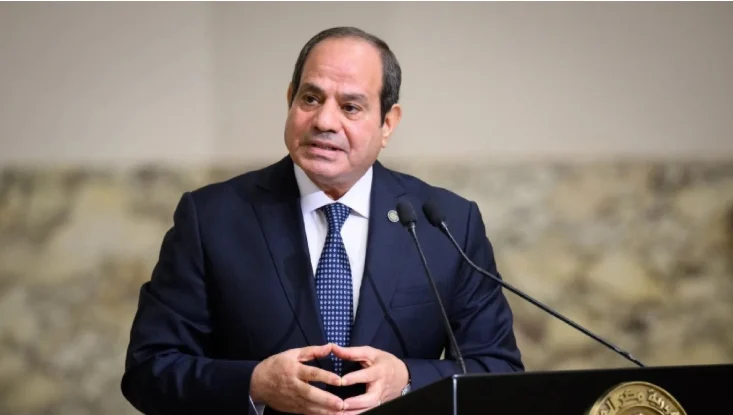
Habi_ President Abdel Fattah El-Sisi participated, this morning, in the "Urban and Community Development" session, as part of the activities of the second day of the Egypt 2026 Forum, in the presence of Dr. Mostafa Madbouly, Prime Minister.
The Official Spokesperson for the Presidency stated that the session addressed the urban development efforts exerted in Egypt since 2014 across the roads, ports, and transportation sectors, including the establishment of factories in Egypt to produce various means of transportation and railway cars, within the framework of industry localization efforts.
The session also addressed related challenges, particularly concerning road networks, railways, subways, and maritime transport. In the same context, the transport sector's status prior to 2014 was reviewed, alongside the achievements made in the sectors of roads, bridges, subways, electric traction, railways, maritime transport, and ports, as well as targeted objectives, governance procedures, efforts to reduce accidents, and the promotion of green mass transit.
It was also emphasized that the State is working to achieve development in this field across all governorates of the republic, addressing the economic, social, and environmental impact of completed and ongoing transport projects.
Ambassador Mohamed El-Shennawy, the Official Spokesperson, added that the session also included a discussion of challenges associated with rural development, drinking water, and sanitation, in addition to efforts to establish residential areas and new cities. The targets related to urban environment development and improving the quality of life across the republic were reviewed, alongside efforts to develop major cities and governorate capitals in 13 governorates, as well as achievements made in eliminating informal settlements.
In this framework, reference was made to the establishment of 61 new cities. The session also addressed the Khedivial Cairo development project, efforts to develop the drinking water sector—including the implementation of 522 projects in this field—as well as the review of sanitation sector development efforts and the implementation status of completed and ongoing housing projects, which have so far included the establishment of 1.96 million new housing units.
The Official Spokesperson noted that the President delivered an intervention, stating that an idealist approach to addressing any existing topic, challenge, or problem is inherently flawed, because many of those who criticize a certain issue present an idealist approach for addressing it.
The President pointed out, for example, that the Egyptian people live on only about 7% of Egypt's area, equivalent to roughly 60 to 70 thousand square kilometers, explaining that this situation has resulted in social, security, cultural, and investment repercussions, and that it is an inhumane situation that contradicts growth opportunities, remaining abnormal despite the Egyptian people's familiarity with it.
He added that the absence of integrated urban planning that keeps pace with the growth witnessed by the State over the years has led to the proliferation of informal settlements surrounding Cairo, the deterioration of transport service levels in Egypt, and the spread of bad practices.
The President explained the difficulty of confronting all challenges simultaneously through idealist proposals, citing current road toll fees, which do not cover the cost of road investments or even their maintenance costs. He also explained that the Egyptian State focused on resolving the electricity crisis and has indeed succeeded in doing so, in order to achieve development and secure the Egyptian State.
Regarding the removal of certain cemeteries, the President noted that this was due to the groundwater problem affecting a large percentage of cemeteries, explaining that the idealist approach to this problem would have been not to touch these cemeteries; however, the realistic approach necessitates dealing with them for legal and humanitarian reasons, and from the standpoint of the State's respect for its citizens.
The President noted that the State has established and is working to establish approximately 70,000 new cemeteries in three phases around the Helwan area and the city of Tenth of Ramadan, explaining that the State has taken these steps to achieve the public interest, including bearing the relevant costs.
The President praised the experience of Mayor Wafai Makady, Mayor of El-Sarareya in Minya Governorate, in facing the challenges of his village, noting that this experience represents a role model that can bring about a major and positive transformation in villages across the republic, in addition to its contribution to alleviating burdens on the State.
The President emphasized the importance of shaping the impression that will form in public opinion and avoiding attempts to agitate citizens, noting the necessity for the media—each from its position—to enlighten public opinion and raise awareness of the facts of matters.
Regarding housing matters, the President directed the government and the Tahya Misr Fund to cooperate in establishing 200,000 rental housing units, with both sharing the cost equally.
The Old Rent Law Aims to Revive the Rental Approach in Housing
In connection with the Old Rent Law, the President emphasized that its goal was to make a breakthrough in the concept of ownership and revive the rental approach in housing, noting that the conditions that prevailed throughout past decades led to the largest crisis of slums and unplanned housing in the Egyptian State, because the State could not replace the private sector and civil society in creating units that meet citizens' demands.
Limited Capabilities and the Scale of Challenges Do Not Permit Achieving Everything We Aspire To
The President added that not everything we aspire to can be implemented given limited capabilities, especially since Egypt is a large country, the scale of challenges facing the State is huge, and the extent of deterioration in State institutions and their trajectory is significant.
He noted that countries grow and develop over a period ranging between 50 and 100 years, and it is unreasonable to imagine completing this within 10 or 12 years. He clarified that he never promised the Egyptian people that, and that achieving the desired development and progress within a period ranging between 20 and 30 years would be the utmost hoped for, by God's grace.
The President stressed the intention to complete the ongoing development and advancement efforts and plans in 2030, praying to God to grant him success in placing the Egyptian State on the threshold of genuine progress, investment, and development, thereby opening up better horizons for the Egyptian people to be managed by colleagues, wishing them success in accomplishing more and achieving further reforms, and noting that what has been accomplished in Egypt could not have been achieved in less than 30 years.
Agreement with Talaat Moustafa Group to Develop 4 Mixed-Use Projects Worth 11 Trillion Pounds
The Official Spokesperson noted that the President also witnessed, on the sidelines of the second day's proceedings of the forum, the announcement of an agreement between the Egyptian State and Talaat Moustafa Group to develop, establish, and operate four major mixed-use projects, valued at 11 trillion pounds. The projects include North Madinaty, a project on an area of 11.3 million square meters in the heart of Alexandria, the establishment of a comprehensive economic unit in the form of an industrial, logistical, and real estate project in the Abu Qir area, in addition to the establishment of a coastal destination on the North Coast similar to "SouthMed".
On this occasion, the President congratulated on the conclusion of the agreement concerning the projects, noting that the State encourages investors to work in all fields, and emphasizing the importance of the community service aspect in investment projects. In this context, he requested the government to cooperate with Talaat Moustafa Group to establish 200,000 rental housing units.
In the same context, the President stressed the necessity of the State's commitment to completing all projects related to the "Decent Life" initiative by a maximum of 2030, noting the importance of partnership with the private sector and the State's support for it.