
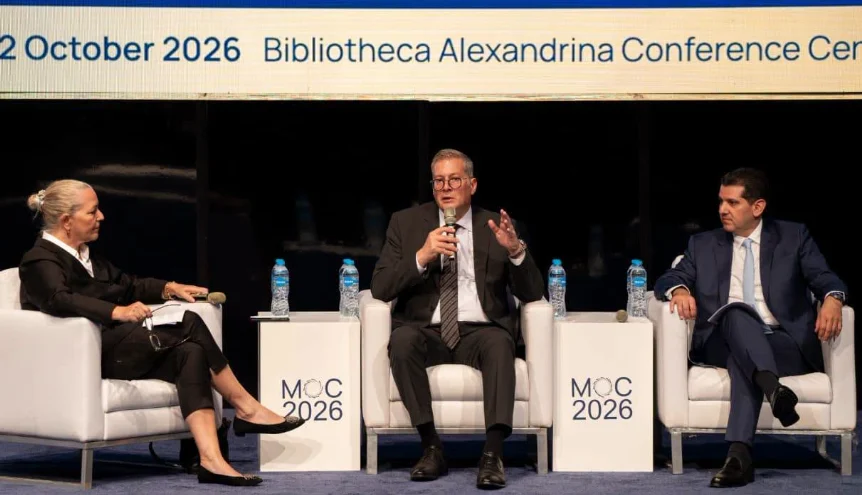
Habi_ Eng. Karim Badawi, Minister of Petroleum and Mineral Resources, affirmed that enhancing regional cooperation and integrating energy infrastructure represent a fundamental pillar for building an integrated energy market in the Eastern Mediterranean, and maximizing the economic utilization of natural gas resources in the region, thereby supporting supply security and opening broader horizons for cooperation and investment in light of the challenges facing global energy markets.
This came during the participation of Eng. Karim Badawi, Minister of Petroleum and Mineral Resources, and George Papanastasiou… [Wait, the Arabic text says Michael Damianos, let me translate literally: George Papanastasiou? No, Arabic says: مايكل داميانوس = Michael Damianos] Michael Damianos, Cypriot Minister of Energy, Commerce and Industry, in the session "Building an Integrated Energy Market in the Mediterranean Region", within the activities of the Mediterranean Offshore Conference (MOC 2026), hosted by Alexandria from October 20 to 22.
The Minister explained that Egypt is working on several integrated axes to enhance energy security, foremost among which is increasing natural gas production, and expanding the use of solar energy and renewable energy sources in cooperation with the Ministry of Electricity and Renewable Energy, contributing to meeting the needs of various sectors and achieving optimal utilization of energy resources.
The Minister stressed that increasing domestic production requires creating an attractive investment environment that ensures visibility, stability, and flexibility of regulatory and commercial frameworks, thereby boosting the confidence of investment partners, supporting the pumping of new investments in exploration and production activities, and helping accelerate the development of gas resources and turning discoveries into actual production that achieves added economic value.
Minister of Petroleum: Modern Technology and Artificial Intelligence Raise Gas Production Efficiency
He pointed out the importance of employing modern technology, artificial intelligence, horizontal drilling, and hydraulic fracturing techniques in raising the efficiency of exploration and production operations, reducing costs and risks, and maximizing the utilization of available resources, in parallel with enhancing cooperation with technology companies to apply innovative solutions in various oil and gas industry activities.
The Minister affirmed that the Egyptian infrastructure represents an important competitive advantage for Egypt and its partners in the Eastern Mediterranean, due to the opportunities it provides for receiving, processing, liquefying, and re-exporting natural gas to target markets, thereby supporting integration between gas resources in the region and available trading potentials, and enhancing the economic viability of development and production projects.
He added that maximizing the utilization of these potentials requires the integration of existing and planned investments in Egypt, Cyprus, and regional countries, and enhancing partnership between governments and private sector companies, enabling the efficient and reliable utilization of resources and infrastructure, and supporting the building of a more interconnected regional market capable of meeting market needs.
For his part, Michael Damianos, Cypriot Minister of Energy, Commerce and Industry, affirmed that regional cooperation represents an increasing necessity in light of the geopolitical developments witnessed by the region and the world, pointing out that the partnership between Egypt and Cyprus achieves mutual interests for both countries and supports efforts to enhance energy security in the Eastern Mediterranean and Europe.
He explained that Cyprus is going through an important phase in the path of exploring and developing its natural gas resources, and is working to intensify research and exploration activities and achieve further discoveries, thereby enhancing the utilization of its gas potentials and supporting its role in the regional energy supply system.
The Cypriot Minister affirmed that Egypt represents a key partner for his country in this path, thanks to its advanced infrastructure for receiving, processing, liquefying, and exporting natural gas, which provides important opportunities to accelerate the development of Cypriot discoveries and achieve the best economic return from them, without the need to build entirely similar infrastructure.
Cyprus Aims to Complete Infrastructure for Domestic Natural Gas Use by 2029
Damianos pointed out that Cyprus seeks to achieve a balance between meeting its domestic energy needs and capitalizing on gas export opportunities, explaining that the infrastructure required for domestic natural gas use is still under development, with a target to complete it by 2029, enabling the use of gas in electricity generation.
Cypriot Energy Minister: Our Gas Needs Range Between 6 and 10 Billion Cubic Meters Annually
He added that Cyprus's natural gas needs are expected to range between 6 and 10 billion cubic meters annually over the coming years, pointing out that exporting discovered gas represents a suitable commercial option at the current stage, in light of domestic market needs and infrastructure development plans.
Regarding the development options for the "Cronus" field, the Cypriot Minister explained that they include transporting gas to Egypt to benefit from its infrastructure, or utilizing the facilities associated with the "Aphrodite" field, allowing the study of available alternatives according to technical and commercial considerations, accelerating the development of discoveries, and maximizing their economic return.
He affirmed that Cyprus aims to contribute effectively to enhancing regional and European energy security, with the possibility of allocating part of its gas resources in the future to meet domestic market needs, thereby achieving a balance between domestic consumption requirements and export opportunities.
The two ministers concluded by emphasizing the importance of continuing coordination and cooperation between Egypt, Cyprus, and Eastern Mediterranean countries, and maximizing the utilization of gas resources and existing infrastructure, thereby supporting the accelerated implementation of interconnection and gas transport projects, enhancing supply security, and turning available potentials in the region into investment opportunities and sustainable economic returns.