
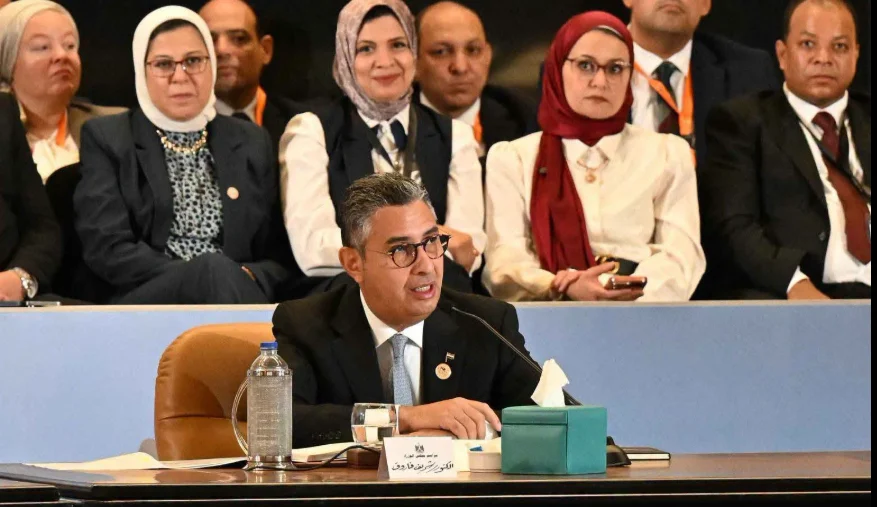
Hapi_ Dr. Sherif Farouk, Minister of Supply and Internal Trade, participated in the session titled “Market Regulation and a More Effective Social Protection System,” held as part of the Egypt 2026 Forum, in the presence of Dr. Moustafa Madbouly, Prime Minister of the Cabinet.
The Minister reviewed developments in the supply subsidy system, proposed trends for developing its delivery mechanisms and enhancing the efficiency of targeting eligible beneficiaries, alongside the Ministry's efforts to protect citizens' purchasing power and develop market oversight using modern digital and technological tools.
The Minister emphasized that the supply subsidy system represents one of the main pillars of social protection, noting that approximately 64.5 million citizens benefit from the subsidized bread system, at a rate of five loaves per day per individual, while the state bears the majority of the production cost.
He added that approximately 57.5 million citizens benefit from the rationed goods system, with each individual receiving, in accordance with current disbursement rules, commodity support worth EGP 50 per month, within the limits of applicable quotas. The state and its affiliated entities bear the cost differentials resulting from the higher prices of procuring goods compared to their selling prices to citizens within the supply system.
He explained that in-kind subsidy allocations included in the budget of the General Authority for Supply Commodities for the fiscal year 2025/2026 amounted to EGP 160 billion, of which EGP 124 billion is for bread subsidies and EGP 36 billion for commodity subsidies. The allocations included in the 2026/2027 fiscal year budget reach EGP 178 billion, of which EGP 142 billion is for bread subsidies and EGP 36 billion for commodity subsidies.
The Minister pointed out that the development of the subsidy system aims to address challenges associated with targeting mechanisms and the diversity of beneficiaries' choices, raise the efficiency of databases, and enhance governance and oversight, thereby ensuring that subsidies are directed to those who deserve them in accordance with social justice standards, and maximizing the utilization of resources allocated for social protection.
In this context, the Minister reviewed the trend towards studying the gradual transition of the system from in-kind subsidies in their current form to more flexible monetary commodity subsidies, enabling citizens to choose their families' essential goods needs according to their priorities, while maintaining the direction of subsidies for food purposes and improving targeting efficiency.
He emphasized that the development is not limited to changing the mechanism for delivering subsidies, but also includes updating databases, disbursement mechanisms, oversight, and the integration of services, thereby enhancing the system's efficiency and its ability to respond to economic variables.
He explained that the proposed concepts include studying different brackets for beneficiaries that take into account the varying needs and economic conditions of families, and providing a more diverse basket of essential food commodities, thereby expanding citizens' choices and granting them greater flexibility in managing their needs.
He stressed the importance of taking price changes into account when developing subsidy mechanisms, in order to preserve their real value and enhance their ability to meet the essential needs of families.
The Minister affirmed that social protection is not complete merely by allocating subsidies, but is also linked to ensuring the availability of goods, stabilizing their prices, and protecting citizens from unhealthy commercial practices. He noted that the Ministry is working to develop the market oversight system, enhance the capacity to detect indicators of imbalance, and intervene proactively.
The Minister reviewed the smart digital oversight system that commenced operation on September 1, 2026, which includes a number of technological tools, foremost among which is the “Price Radar” to monitor the movement of commodity prices and track geographical changes, Geographic Information Systems (GIS) to determine the locations of Ministry outlets, analyze coverage, and monitor gaps, alongside the “Inspector Card” to document inspection campaigns and visits and raise the efficiency of field follow-up.
He added that the system relies on daily price monitoring and the utilization of artificial intelligence models to forecast food commodity price movements, in parallel with utilizing reports and bulletins issued by the Information and Decision Support Center of the Cabinet and the Central Agency for Public Mobilization and Statistics (CAPMAS), thereby supporting data-driven decisions and enhancing the efficiency of regulatory interventions.
The Minister concluded by emphasizing the continuation of the Ministry of Supply and Internal Trade's efforts to develop the subsidy system and raise the efficiency of market oversight, thereby ensuring that subsidies reach those who deserve them, the regular availability of essential goods, the protection of citizens' purchasing power, and the support of market stability.