
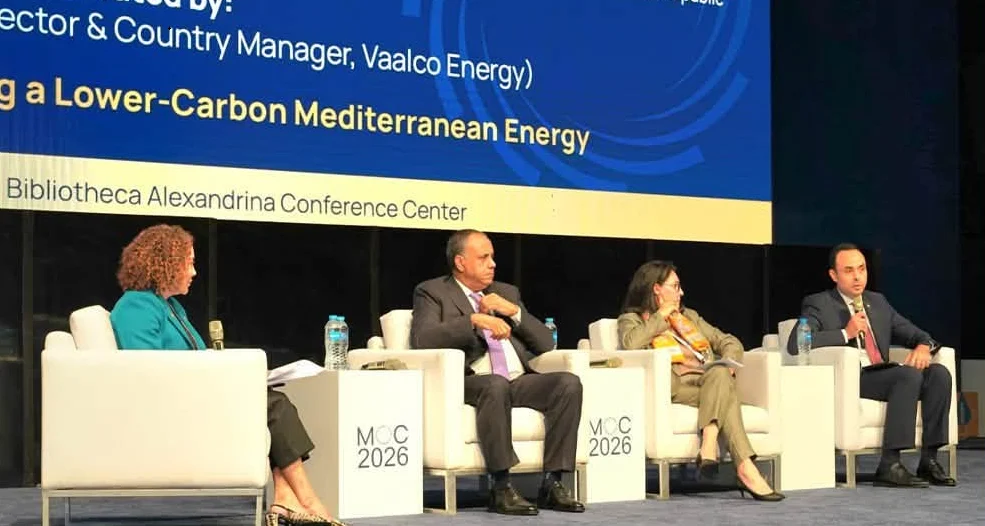
The Mediterranean Offshore Conference and Exhibition (MOC 2026), inaugurated by Engineer Karim Badawi, Minister of Petroleum and Mineral Resources, at the Bibliotheca Alexandrina, witnessed a series of important panel discussions during which petroleum sector leaders reviewed plans to enhance local production, foster a more competitive investment climate, secure energy supplies, develop exploration and research activities, alongside accelerating the application of technological solutions to reduce emissions and maximize the economic value of natural gas resources.
The discussions, with the participation of heads and officials of international and local energy companies, addressed opportunities to enhance Egypt's position as a regional hub for energy trading and commerce, in light of its advanced infrastructure and prime geographical location, as well as the investment opportunities it provides in petroleum, gas, and petrochemical activities.
During the session entitled "Gas in Transition: Building a Low-Carbon Energy System in the Mediterranean," moderated by Iman Hill, Managing Director and Regional Director of Pharos Energy, Engineer Salah Abdel Karim, CEO of the Egyptian General Petroleum Corporation (EGPC), reviewed the corporation's efforts to enhance investment attractiveness in the Egyptian petroleum industry, increase local production, and narrow the gap between production and consumption.
Salah Abdel Karim: Raising Refinery Operating Efficiency from 63% to 82% and a Seismic Survey Program in the Western Desert Covering Approximately 110 Thousand Square Kilometers
Abdel Karim emphasized working on creating a more competitive investment climate through providing incentives and facilities, developing the petroleum operations system, and enhancing the flexibility and transparency of petroleum agreements, in line with global variables and encouraging investment partners to inject more investments, especially international companies possessing financial capabilities and advanced technological expertise.
As part of reducing exploration risks and enhancing the prospects of discovering new petroleum resources, he explained that work is underway to implement a large-scale seismic survey program in the Western Desert covering an area approaching 110,000 square kilometers, providing high-precision data that supports investment decisions in exploration and research activities, in addition to expanding the application of the latest seismic survey technologies in the Gulf of Suez in cooperation with GUPCO.
Regarding increasing production and maximizing the utilization of existing assets, he pointed out the importance of maintaining the sustainability of the achieved increase in petroleum production, in parallel with raising the operating efficiency of refineries and maximizing the utilization of their capacities, explaining that the comprehensive and planned inspection and maintenance works carried out during the past year contributed to raising refinery operation rates from 63% to 82%, enhancing the ability to meet local market needs and contributing to reducing the import bill.
Long and Short-Term Contracts with Global Suppliers to Provide Crude and Petroleum Products
He also reviewed the measures taken to ensure the stability of energy supplies by concluding long and short-term contracts with global suppliers to provide crude and petroleum products, primarily butane, while diversifying import sources and methods and utilizing ports and logistical facilities on the Red and Mediterranean Seas, including the Ain Sokhna port, SUMED pipeline facilities, and Mediterranean ports.
He stressed that diversifying import gateways represents an important element in enhancing the flexibility of the supply system, raising its ability to deal with security, regional, and international challenges, and ensuring the continuity of energy flows to the local market.
Mahmoud Nagi: Emissions Reduction and Energy Efficiency are Two Pillars for Enhancing the Competitiveness of Egyptian Industry
Meanwhile, Engineer Mahmoud Nagi, Undersecretary of the Ministry of Petroleum and Mineral Resources, Supervisor of Safety, Environment, Energy Efficiency, and Climate, and Official Spokesperson of the Ministry, affirmed that the transition in the energy sector requires achieving a balance among three main axes: energy security, sustainability, and affordability, ensuring the provision of reliable and affordable supplies while protecting the environment and preserving resources for future generations.
He explained that raising energy use efficiency and rationalizing it represent a core axis in development efforts, as they achieve reduced fuel consumption, lower operating costs, and maximized resource utilization, pointing out that these efforts align with the fifth axis of the Ministry of Petroleum and Mineral Resources' strategy, related to improving energy efficiency, reducing emissions, and managing methane emissions.
Regarding the application of Carbon Capture, Utilization, and Storage (CCUS) technology, Nagi emphasized that handling this technology is moving towards examining practical applications and viable projects, providing promising opportunities to reduce industrial emissions and enhance the competitiveness of Egyptian products, especially in the fertilizer and cement industries, and maintaining their competitive edge in export markets, particularly European markets in light of increasing requirements related to the carbon footprint of products.
He pointed out the selection of the fertilizer sector as a promising initial opportunity to develop a project in this field, with candidate sites for underground carbon dioxide storage identified, and working on preparing regulations and a comprehensive regulatory framework to apply this technology in cooperation with a specialized international consultant to be selected.
Pilot Project in Hammam Faraun Area to Generate 1.5 Megawatts of Electricity Using Geothermal Energy
In the field of geothermal energy, he explained that the ministry is evaluating opportunities to utilize it as an alternative to diesel generators in certain applications, noting the identification of a pilot project in the Hammam Faraun area to generate 1.5 megawatts of electricity, alongside studying a project in a petroleum sector company to replace diesel-powered electricity generation units with geothermal energy.
Dr. Samir Roushdy: Awarding Approximately 70% of Offered Areas in the Mediterranean to Various Companies
During a session on opportunities to exploit gas resources in the Mediterranean region, Dr. Samir Roushdy, Chairman of South Valley Egyptian Petroleum Holding Company (Ganope), affirmed that international reports indicate that discovered gas potentials in the region do not exceed approximately 30%, reflecting the scale of opportunities available for exploration and research activities in the coming years.
He explained that maximizing the utilization of these potentials requires continuing to improve the financial and economic terms of projects and raising the quality of data available to investors, pointing to the efforts made by the Ministry of Petroleum and Mineral Resources to enhance direct dialogue with companies and provide exploratory data supporting investment decisions through seismic survey projects and making investment opportunities available.
He added that the ministry has successfully offered multiple areas and opportunities in the Mediterranean to companies and made their data available, contributing to awarding about 70% of the offered areas to various companies.
Roushdy noted that gas exploration and production from deep waters, which may reach a depth of 3,000 meters, imposes significant technical and investment challenges in light of high field development costs, making expected reserve volumes and development costs key factors in evaluating the economic feasibility of projects.
He emphasized the continuation of work to reduce the timeframe between awarding bids and commencing implementation, accelerating evaluation procedures and obtaining approvals, thereby raising the efficiency of the investment cycle and enhancing Egypt's competitiveness in attracting exploration and research investments compared to other markets.
Alaa Abdel Fattah: A New Roadmap for Developing the Petrochemical Industry in Egypt
For his part, Chemist Alaa Abdel Fattah, Chairman of the Egyptian Petrochemicals Holding Company (ECHEM), affirmed that the company is working on preparing a new roadmap to develop the petrochemical industry, based on meeting local market needs and maximizing the added value of natural gas by converting it into products used in numerous industries, achieving a higher economic return than using it as a raw material or fuel.
He explained that the holding company has about eight producing petrochemical companies under its umbrella, whose products enter into many industries associated with daily life, noting that about 95% of these companies' products rely on natural gas, alongside other hydrocarbon inputs.
1.6 Billion USD Added Value from Converting Gas into Petrochemical Products
He reviewed the economic indicators of the industry, explaining that company sales reached about 42 billion Egyptian pounds, while exports recorded about 1.8 billion USD, and the added value generated from converting raw gas into petrochemical products reached about 1.6 billion USD, reflecting the importance of maximizing local manufacturing and raising the economic return from energy resources.
Abdel Fattah praised the efforts of Engineer Karim Badawi, Minister of Petroleum and Mineral Resources, in securing natural gas supplies for the petrochemical industry, stressing that supply stability is a key element to ensure the regular operation of factories and the implementation of their production plans.
He added that regional cooperation in the field of gas, including cooperation with Cyprus, represents one of the elements taken into consideration when preparing the new roadmap, alongside local market needs and the economic feasibility of proposed projects, supporting the growth of the petrochemical industry and maximizing its contribution to production, exports, and foreign currency generation.