
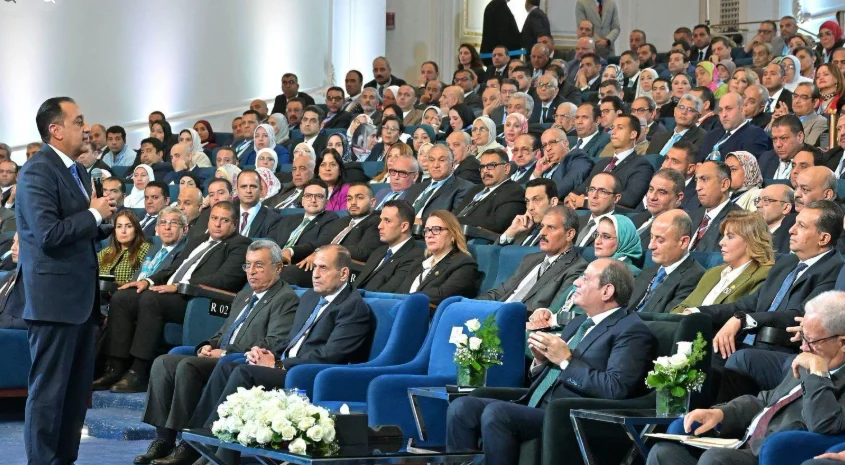
Dr. Mostafa Madbouly, Prime Minister of the Cabinet, delivered a speech during the session entitled "Egypt's Energy Journey: National Achievements and Future Horizons," held as part of the activities of the fourth day of the "Egypt 2026 Forum," under the auspices of President Abdel Fattah El-Sisi, President of the Republic.
The State's General Budget Set a Price of $75 per Barrel of Oil
At the beginning of his speech, Dr. Mostafa Madbouly emphasized that the exceptional and unprecedented circumstances witnessed globally require the State to deal with current economic variables with utmost precision and responsibility. He noted that the State's general budget set a price of $75 per barrel of oil, whereas the price has currently risen to approximately $110 per barrel.
He explained that the repercussions of this increase are not limited to fuel prices used in transportation, but also extend to natural gas used in energy production, thereby imposing additional burdens on the State.
The Prime Minister stated that addressing this increase presents the State with three main options: the first is to pass the full cost increase onto the citizen, similar to the measures taken by many countries, whether developing or economically advanced. The second option is for the State to bear the increase in full, which requires the availability of sufficient financial resources or resorting to borrowing to cover these burdens. He pointed out that borrowing is not a cost-free solution, as it entails additional burdens in the form of due interest, which increases the volume of public debt and financial obligations on the State in the future.
In this context, Dr. Mostafa Madbouly indicated that borrowing today imposes doubled obligations on the State in coming years, explaining that the amount borrowed by the State could double in due value to about twice as much within seven years as a result of accumulating interest burdens, which means placing further financial burdens on future budgets.
He added that resorting to this option may expose the government to criticism from some economic experts due to the increase in public debt, without taking into account the magnitude of the burdens borne by the State to mitigate the impacts of global increases on citizens.
The Prime Minister added that the third option is to maintain the financial allocations specified in the budget and purchase quantities of petroleum products according to new prices within the limits of available resources. This may lead to meeting only about 50% or 60% of citizens' needs, resulting in fuel shortages and unavailability in the required quantities at service stations.
Within this framework, Madbouly explained that such a scenario may necessitate taking more difficult measures, including resorting to load shedding for periods ranging between six and eight hours daily, as indicated by the President, reflecting the magnitude of repercussions that could result from the lack of necessary resources to meet energy needs.
Weighing These Options Requires Balancing the Protection of Citizens from Repercussions with Preserving the Stability of the National Economy
He emphasized that weighing these options requires balancing the protection of citizens from the repercussions of global hikes with preserving the stability of the national economy, avoiding the imposition of additional financial burdens on future generations, and taking into account the priority and essential needs of the State and citizens.
Securing the Financial Appropriations Necessary to Provide Fuel Shipments Is One of the Most Difficult Challenges
The Prime Minister also stated that one of the most difficult challenges facing the economic group, in coordination with the Governor of the Central Bank, is the weekly meeting to secure the financial appropriations necessary to provide the shipments required by the State. He explained that the cost of these shipments has witnessed a significant increase, despite efforts to rationalize consumption and increase the contribution of new and renewable energy in the energy mix. He noted that the value of shipments that the State imported two years ago at a certain cost is now equivalent to twice that cost, and this is the current status quo.
He explained that these meetings are not limited to a single day, but extend to two or three days a week, which is not highlighted in the media. These meetings aim to coordinate the provision of financial resources, whether in Egyptian pounds or US dollars, to meet the State's needs.
Madbouly added that in light of the crisis, the original plan was for the share of new and renewable energy in Egypt's energy mix to reach 42% by 2030, through expanding solar energy, wind energy, and nuclear energy projects while utilizing battery storage technologies.
Targeting to Reach 45% of New and Renewable Energy in the Energy Mix by 2028
He noted that President Abdel Fattah El-Sisi directed the need to look ahead to the future and accelerate the increase of these rates. Therefore, steps were brought forward and expedited so that the target is to reach 45% of new and renewable energy in the energy mix by 2028.
He explained that the President also directed working through the arms established to assist the State, such as the Tahya Misr Fund and the "Mostakbal Masr" (Future of Egypt) Agency, to increase the proportion to 50% of new and renewable energy by 2030, instead of the 42% targeted in the initial plan.
200 Billion Egyptian Pounds Is the Cost of Implementing the Networks Required to Reach 45% by 2028
The Prime Minister stated that he would suffice by mentioning a single figure reflecting the volume of cost required to rehabilitate electricity networks. He explained that President Abdel Fattah El-Sisi inquired about the cost of establishing a solar energy plant or another for wind energy, within the framework of expanding new and renewable energy projects. He clarified that the cost of implementing the networks required to reach 45% by 2028 amounted to approximately 200 billion pounds, stressing that the State has provided the necessary financial allocations and included them in its plan to implement these projects.
He added that there is another program extending until 2030, targeting to reach 50%, and work is underway to implement it in cooperation with relevant entities and various state arms, thereby supporting the stability of the energy system and enhancing its capacity to meet growing demands.
He also emphasized that reviewing these figures aims to inform citizens of the volume of efforts exerted by the State to secure their essential needs, ensure the continuity of electricity supplies, ensure the availability of fuel at service stations without congestion, as well as the continued availability of goods in the markets.
The State Still Bears and Will Continue to Bear the Lion's Share of the Cost of Providing Energy During the Short Term
In this context, the Prime Minister raised a question: "Do we charge the citizen the real price?" He explained that comparing the actual cost of producing a liter of gasoline or a kilowatt of electricity with the price borne by the citizen demonstrates the volume of burdens borne by the State. He affirmed, without delving into detailed figures, that the State still bears and will continue to bear the lion's share of the cost of providing energy to the Egyptian citizen during the short term.