
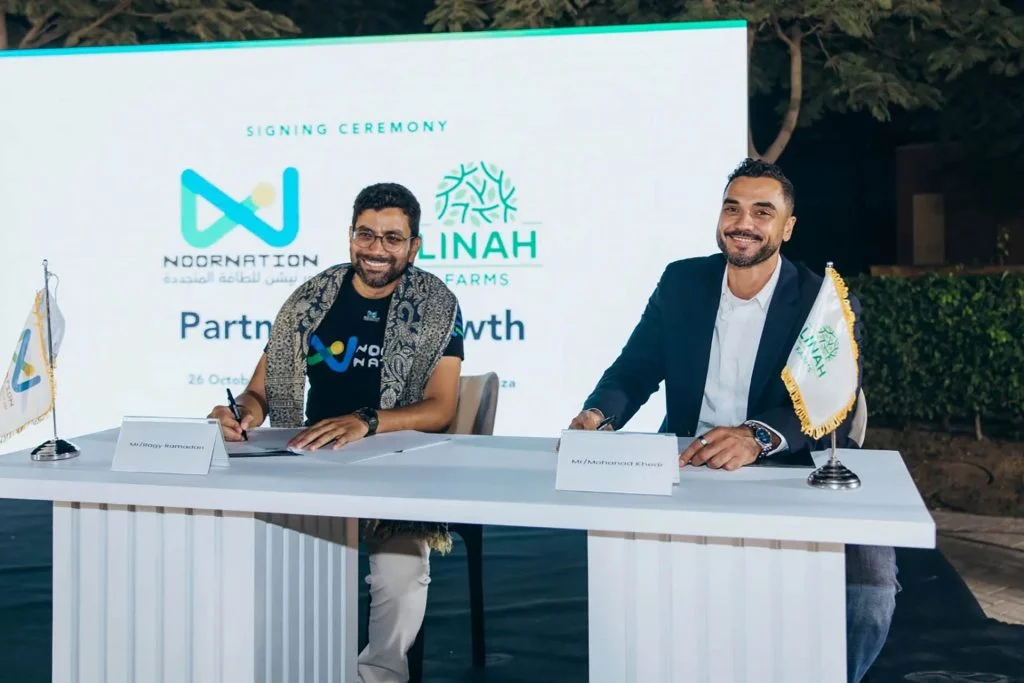
Cairo-based solar energy and water startup Noor Nation has closed a $1.05 million seed funding round, with participation from agribusiness group Leena Farms, climate tech-focused African venture fund Catalyst, and Saudi venture capital firm KBW Ventures, according to Ragy Ramadan, the company's founder and CEO (LinkedIn), during an event attended by the EnterpriseAM morning newsletter last Monday. Ramadan explained that Leena Farms signed the deal during the event after 9 months of due diligence, turning one of Noor Nation's major clients into a shareholder in the company.
This round shifts Leena Farms from a mere commercial energy-buying client to a strategic investor and development partner, formalizing a contract under which Noor Nation will build 5 solar power plants with a total capacity of 1.1 MW on Leena Farms' properties in the Bahariya Oasis and Minya.
Leena Farms has been searching for a solar energy partner for years; the group transitioned from hospitality to agriculture in 2010, and a full decade passed without taking a decisive step toward solar energy, even after measuring its carbon footprint. The reason for this was that it was looking for a partner with the technical capability to deploy solar energy systems on a large scale across its various operations, according to Mohannad Khodr, founder and managing partner at Leena Farms.
3 pilot projects convinced Leena: Mohamed Wahdan, CEO of Leena Farms, stated that all 30 wells at the group's Magdoul Date Farm in the Bahariya Oasis, spanning 3,000 acres, were running on diesel when the group measured its carbon footprint in 2021-2022. Wahdan added that the first project Noor Nation executed there was a hybrid system combining solar and diesel for a well reaching a depth of 1,000 meters, monitored via a real-time dashboard comparing the two energy sources. Noor Nation then implemented a solar system equipped with batteries at the farm's palm agriculture school, and a 400 kW system at Leena Farms' Sultan Gardens Resort in Sharm El Sheikh, which features 520 rooms. Ramadan noted that the Bahariya Oasis well saved over EGP 3 million in diesel costs, while the Sultan Gardens Resort reduced its national grid electricity bill by more than EGP 2.2 million.
Expanding the solar-powered irrigation-as-a-service model: Leena Farms will also contribute as a partner in financing Noor Nation's pay-as-you-go irrigation model targeting smallholder farmers, alongside other partners including the World Food Programme, according to Ramadan. Farmers pay nothing upfront; Noor Nation installs the solar-powered LifeBox unit, converts the farm from flood irrigation to drip irrigation, and then charges farmers for water by the hour, with the ability to top up credit via the MyFawry app, according to Mohamed Khaled, co-founder and Chief Technology Officer at Noor Nation (LinkedIn).
Noor Nation contracts through local community development associations to mitigate repayment risks, with ownership of the systems transferring to the farmers after 5 to 7 years, according to Ramadan. Khaled explained that 3 pilot projects are already operational and generating revenue, the first of which is in Aswan in cooperation with the World Food Programme and the Adaptation Fund.
The importance of funding: Agriculture accounts for about 13.7% of GDP and 19% of employment, and around 94% of Egypt's water needs rely on the Nile River. Nevertheless, a large part of the sector still operates on diesel. Ramadan said that about "95% of old-land farmers still irrigate with diesel pumps," which represents a burden on both farmers and the state, as diesel is one of the largest items on Egypt's import bill. Likewise, most of them rely on flood irrigation, which wastes "about 70% of Nile water," according to Khaled. Most farmers cannot afford to buy a solar-powered pumping station all at once, as a 20-horsepower station costs about EGP 1 million, according to Ramadan, an obstacle that the pay-as-you-go model aims to overcome.
About the company: Noor Nation officially launched in March 2022, developing and assembling its systems in a factory in the Abu Rawash area. These systems range from LifeBox units, which power pumps and desalination plants with solar energy without batteries, to grid-tied systems for hotels and factories. Ramadan stated that the company has implemented about 66 projects with a total capacity of 7 MW across 13 governorates, serving more than 5,200 acres. Outside Egypt, the company has executed projects in the UAE and supplied hospitals in Tajikistan with two LifeBox desalination units in cooperation with UNICEF. By the end of December, Noor Nation will also launch a new version of its platform featuring automated irrigation and soil and water remote sensing.