
Two of Egypt's largest solar energy and energy storage projects have progressed further this week, albeit on completely different tracks; contractors have commenced full construction works on the Nafr El Minya project, while the Dandara project is still signing the preliminary terms for its financing, despite having signed its power purchase agreement in March 2025.
Norway's Scatec signed the preliminary financing terms for the Dandara project with 3 development banks, namely the European Investment Bank, the European Bank for Reconstruction and Development, and the African Development Bank, last Monday, according to a statement issued by the Cabinet. The document outlines the project's financing mechanism, but it is not a loan agreement, as each lender must still complete the due diligence and obtain credit approvals before committing to disburse funds.
The terms cover a 1 GW solar power plant and 200 MWh energy storage batteries in Naguhammadi, Qena Governorate, with a total cost of approximately USD 650 million. The project will be implemented in two phases, each with a capacity of 500 MW and a storage capacity of 100 MWh per phase, and is expected to cover about one-third of Egypt Aluminum's electricity needs. This step is of particular importance to the smelter, as the European Union's Carbon Border Adjustment Mechanism entered into force last January, noting that Egypt Aluminum exports 60% of its production to Europe. Scatec's new platform in Egypt — supported by the European Bank for Reconstruction and Development with financing of up to USD 221 million — is expected to acquire about 60% of the project's first phase.
The signing ceremony itself also resulted in two other agreements: the first for grid interconnection between the Egyptian Electricity Transmission Company and the Holding Company for Metallurgical Industries, the parent company of Egypt Aluminum, and Dandara Solar Energy Company. The second relates to the National Bank of Egypt acquiring an undisclosed stake in the project.
Financing is ready and the cranes are operating
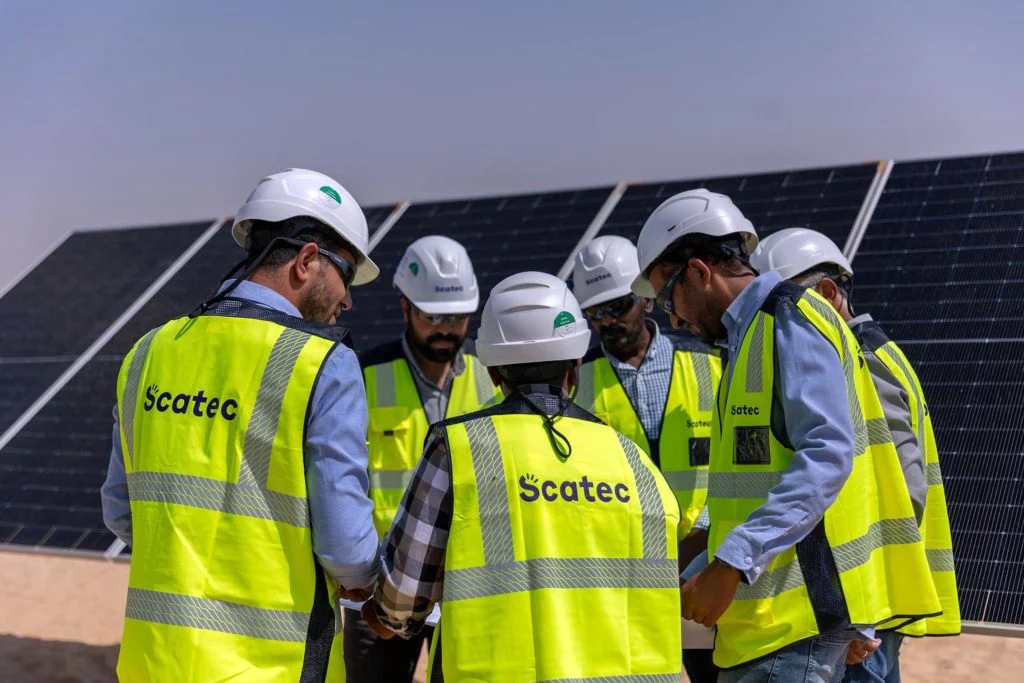
Full construction works have commenced in West Minya, after the project owners signed the Notice to Proceed (PDF) and the engineering, procurement, and construction works for a 1.2 GWp solar power plant and 600 MWh energy storage batteries. The execution is undertaken by a consortium comprising Hassan Allam Construction and Sterling and Wilson, after preliminary works began last June, with commercial operation scheduled to start in September 2027. The plant is expected to produce enough electricity for about 1.4 million homes and contribute to reducing carbon dioxide emissions by 1.59 million tons annually.
The project closed its financing last week. It signed the power purchase agreement in November 2025, and the European Bank for Reconstruction and Development, alongside a group of development lenders, arranged a debt package worth USD 566 million, led by the bank with a USD 265 million tranche, comprising USD 160 million from its own resources, a USD 75 million tranche "B" loan from the Bank of Jordan, and up to USD 30 million in concessional financing. The remaining financing comes from the German Investment Corporation (DEG), the Dutch Entrepreneurial Development Bank (FMO), and the French Proparco, backed by a 25-year power purchase agreement with the Egyptian Electricity Transmission Company.
Both projects rely on the European Bank for Reconstruction and Development and 25-year power purchase agreements, but they sell electricity to two different parties; the Dandara project feeds an exporting company that sells its production in Europe, while the Nafr El Minya project sells electricity to the national grid, using its batteries to shift midday production to evening peak hours. However, the storage capacity in neither project is sufficient to power the plant throughout the night, as Dandara's storage capacity is 200 MWh compared to a production capacity of 1 GW, while Nafr El Minya's storage capacity is 600 MWh against 1.2 GWp. Nevertheless, the most prominent difference between them now lies in timing; while the Dandara project is still gathering preliminary financing commitments since October 2025, the Nafr El Minya project has closed its financing file and its cranes have already commenced work.