
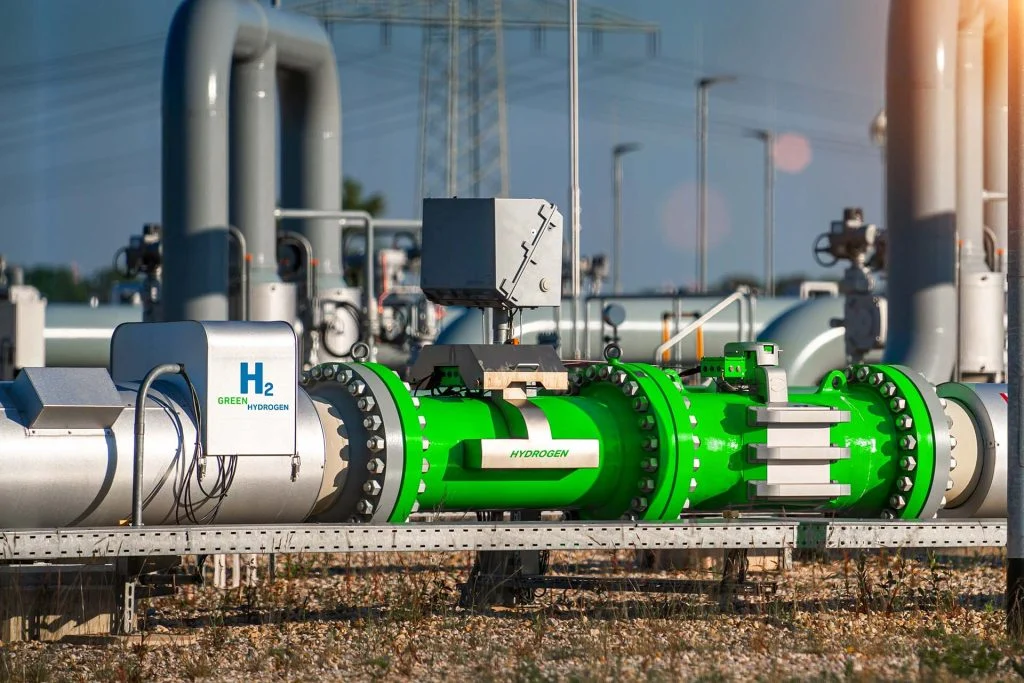
The list of green hydrogen projects in Egypt has shrunk to a limited number after 20 companies pulled out of their agreements with the government. The Ministry of Electricity listed the names of companies that withdrew, faltered, or allowed their agreements to expire without meeting the required prerequisites, in a written response to a request for clarification submitted by MP Yasser El Hodeiby, published by Attaqa website last week. The ministry attributed the trend to slowing European demand, a lack of long-term off-take agreements, and rising production and financing costs. Additionally, the cost of transmitting electricity generated from renewable energy to the hydrogen hub in Sokhna burdened many developers, according to statements made by Osama Fawzy, founder of Hydrogen Intelligence, to Enterprise morning newsletter.
The list of withdrawals includes prominent companies that underpinned the massive headline figures of 2022 and 2024, comprising 7 out of 9 framework agreements signed during the 27th UN Climate Change Conference (COP27) with a total value of up to USD 83 bn, according to our calculations, alongside seven companies that signed MoUs worth USD 41 bn in February 2024.
Withdrawal cases varied between formal pullouts and the expiration of MoUs without fulfilling specified requirements, according to the ministry's response. Fortescue and Globaleq requested the termination of their framework agreements, while Maersk officially apologized for not proceeding. The consortium comprising Total and Enara failed to submit the preliminary feasibility study within the set deadline. Alfanar, China Energy, AMEA Power, ReNew Power, the consortium of Taqa and Voltalia, Germany's DAI, and the four-party alliance between Masdar, Infinity, Hassan Allam Utilities, and BP did not complete the implementation procedures for their projects. Scatec also withdrew, despite its continued participation in the "Egypt Green Hydrogen" project. As for the remaining eight companies, they allowed their MoUs to expire without submitting the required studies, noting that all of them signed those MoUs in February 2024, except for one company.
Some developers also postponed projects in Oman, Europe, and Southeast Asia, while others pulled out due to geopolitical uncertainty, according to Fawzy, who added: "We should not portray Egypt as the only country from which developers have withdrawn."
Costly lines and cautious off-takers
Connecting electricity generated from renewable energy to Sokhna entailed costs that prompted some developers to withdraw. The Egyptian Electricity Transmission Company (EETC) set high tariffs for transmitting electricity supplies to the hydrogen hub located northwest of Sokhna Port via the national grid, according to Fawzy, noting that the transmission distance from Benban to Sokhna ranges between 800 and 900 kilometers. The state then granted developers the option to construct transmission lines at their own expense from their wind and solar generation sites in Ras Gharib, Ras Shokeir, and Zafarana, located 80 to 200 kilometers away. Fawzy believes that selling electricity to EETC yields better returns for some companies owning wind and solar power plants compared to a hydrogen project costing between USD 4 bn and USD 5 bn.
On the flip side, off-takers are taking a wait-and-see approach. The new electrolysis capacity added by the European Union in 2024 was limited to just 308 MW, representing only about 7.7% of its annual target of 6 GW. Furthermore, the volume of new global off-take agreements shrank to 1.7 mn tonnes per year in 2024, down from 2.4 mn tonnes in 2023, according to the ministry. The ministry explained in its response that the cost of unsubsidized green hydrogen still ranges between EUR 4 and EUR 7 per kilogram across most of Europe, compared to EUR 1.5 to EUR 2.5 for grey hydrogen produced from natural gas. Buyers expect the cost of green hydrogen to continue declining and are therefore hesitant to commit to purchases now, according to Fawzy. Off-takers also want projects to reach specific milestones toward completion before signing, according to statements made by Hussein Reyhan, Head of Egypt Business at Acme Group (ACME), to Enterprise morning newsletter. However, on the other hand, no project can reach a Final Investment Decision (FID) without off-take agreements covering most of its intended output, he added.
A limited number of projects are still moving forward
The Egypt Green Hydrogen project is the most advanced. The Sovereign Fund of Egypt signed the agreement for the project, which targets establishing a 100 MW plant, with Scatec, Fertiglobe, and Orascom Construction in July 2024, noting that Fertiglobe committed to off-taking the plant's entire green ammonia output for 20 years. The ministry informed the House of Representatives that the first phase of the project is operational and has commenced exports to European and US markets, with expectations of reaching FID for full production capacity in 2027 or 2028. However, Fawzy presents a more conservative timeline, stating that the pilot plant inaugurated during COP27 operated at a capacity of 5 to 10 MW out of 15 MW, and that production from 100 MW electrolyzers—the units that split hydrogen from water—will begin around early next year, with another 100 MW to be added in 2028. Fertiglobe had previously secured a EUR 397 mn supply contract for green ammonia to the EU via Germany's H2Global program, as previously reported.
The consortium comprising EDF and ZeroWaste plans self-generation of power, and Fawzy expects ACWA Power to follow suit. The consortium will produce hydrogen and ammonia directly adjacent to its wind and solar plants in Ras Shokeir, via 10-to-15 km pipelines and a dedicated maritime jetty on the Red Sea, according to Fawzy, who added that the consortium has reached the final feasibility study stage and is scheduled to announce financial closure in mid-2027. In its latest meeting, the National Green Hydrogen Council approved extending the MoU for allocating land in the East Nile area for ACWA Power's project—which will produce 66k tonnes of green hydrogen and 500k tonnes of green ammonia—for an additional year, according to a Cabinet statement. Fawzy expects ACWA Power to construct its wind and solar generation plants first, then allocate a portion of its output to hydrogen.
Acme has also secured approval for land allocation for a solar plant, and will construct a dedicated transmission line to Sokhna. The Council approved the request submitted by India's Acme to allocate 12 sq km in West Zafarana to establish a 600 MW solar plant to feed the pilot phase (100k tonnes per year) of a green ammonia project with a total capacity of 1 mn tonnes per year, to be executed in phases, according to the Cabinet. Reyhan stated that Acme will extend a dedicated line from the plant to its ammonia facility in Ain Sokhna, and will determine the final optimal mix of solar units and battery storage systems once the land coordinates are defined.
Binding terms?
MP Marwa Bareiss calls for linking any future extensions to clear obligations. Bareiss told Enterprise morning newsletter: "The response of the Ministry of Electricity confirms what we raised in the request for clarification regarding the gap between announced investments and actual execution, but it did not clarify the volume of realized investments or economic returns compared to targets." Bareiss wants any extension linked to a binding timeline, completion of feasibility studies, execution of long-term off-take agreements, and proof of committed financing, adding: "MoUs should not turn into a means to hold state land and resources without actual investment."
Fawzy suggests requiring similar commitments while launching projects with small initial capacities, arguing that developers should first submit a technical and economic feasibility study, agreements with electrolyzer suppliers, proof of committed financing, and preliminary engineering design, followed by signing a final agreement with the state granting developers between 36 and 45 months for execution. He also proposes establishing small modular plants with a capacity ranging between 20k and 50k tonnes per year to prove proof-of-concept, with the state acting as a local off-taker.