
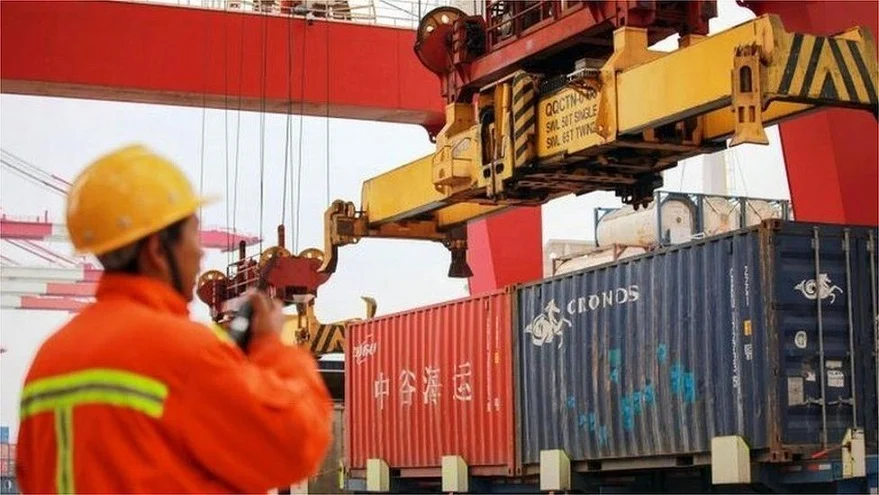
Reuters – The Chinese economy grew at a faster-than-expected pace in the third quarter, as a surge in exports and strong factory activity offset continued weakness in domestic demand, easing pressure on policymakers to unleash more aggressive stimulus measures.
Data from the National Bureau of Statistics released on Monday showed that Gross Domestic Product (GDP) grew by 4.5% year-on-year during the three months ending September 30, beating analysts' expectations of a 4.4% growth, and accelerating from a 4.3% growth in the previous quarter.
The strong growth in the main indicator was supported by a rise in exports, as China's trade surplus widened more than expected in September, keeping the country on track to surpass last year's record surplus of $1.2 trillion.
Industrial Production and Retail Sales Beat Expectations in September
Retail sales grew 1.1 percent in September, improving from a 0.4 percent increase in August and compared to expectations of a 0.6 percent rise. This was the fastest growth since March. However, consumer spending remained generally weak, highlighting the unbalanced nature of the recovery.
Industrial production rose 5.5 percent in September, accelerating from a 5.2 percent growth in August and matching expectations. This was the fastest growth in six months, underscoring the continued resilience of the manufacturing sector.
Policymakers refrained from launching broad-based stimulus, betting that strong exports, backed by a global tech boom led by artificial intelligence, would keep growth on track to achieve the annual target ranging between 4.5 and 5 percent.
GDP Growth Reaches 4.6% in 9 Months
From January to September, the economy grew by 4.6 percent, placing it within the range of the government's target for annual growth of between 4.5 and 5 percent.
Yuhan Zhang, Senior Economist at The Conference Board China Center, stated: “The main macroeconomic message is that China's economy remains driven by supply and production.”
He added: “This supports near-term growth and industrial upgrading, while ongoing efforts to boost household consumption, demand for services, and consumer confidence should render the recovery more balanced and sustainable.”
Export Strength Offset Continued Weakness in Domestic Demand
Beijing has relied heavily on exports to drive growth this year, but this engine is facing growing pressure amid lingering weakness in domestic demand and escalating trade tensions with the European Union. An agreement with the European Union to curb shipments of Chinese hybrid vehicles could impact the booming automobile trade.
China's strategy of shifting credit and resources from the real estate sector to high-tech industries has led to a multi-speed economy, where the strength of factory production and exports masks weakness in consumption and private investment.
Beijing recently expanded support for homebuyers, unveiled measures to channel cheaper credit into sectors including infrastructure and technology, and allocated 550 billion yuan ($82.28 billion) from unused government debt quotas to ease fiscal pressure on local governments and expand infrastructure investment.
Authorities also boosted financial support, including expanding loan interest subsidies for small private companies and consumers, and utilizing an 800 billion yuan policy-based financing tool to stimulate infrastructure investment.
Nevertheless, infrastructure investment contracted by 4.2 percent.
Fixed Asset Investment Declines 7.2% Over 9 Months
Fixed asset investment fell by 7.2 percent in the first nine months, at the same pace recorded during the period from January to August.
Tianchen Xu, Senior Economist at the Economist Intelligence Unit, said: “An improvement in government investment helped stem the ongoing deterioration in fixed asset investment.”
However, investment in real estate remained weak, falling 20.6 percent in the first nine months of the year.