
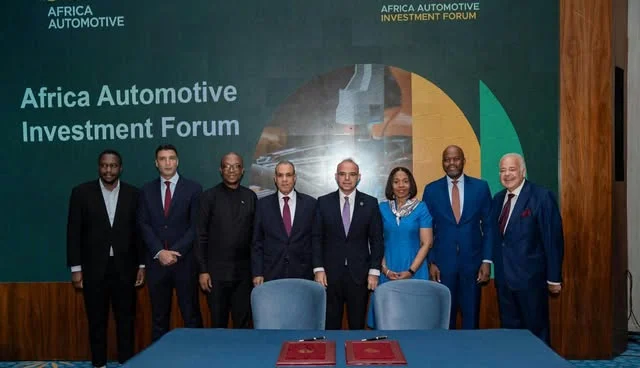
Samar El-Sayed_ African Export-Import Bank ("Afreximbank") affirmed that the automotive sector represents a strategic priority and a strong catalyst for industrialization in Africa, enhancing intra-African trade and economic resilience.
In partnership with the African Association of Automotive Manufacturers (AAAM), the Secretariat of the African Continental Free Trade Area (AfCFTA), the Egyptian Ministry of Trade and Investment, and the South African Department of Trade and Industry, the Bank hosted the Africa Auto Investment Forum, recently held on the sidelines of the African Alamein Forum in the city of Alamein, Egypt.
The two-day forum brought together top policymakers in the African automotive industry, private sector original equipment manufacturers (OEMs), and component manufacturers operating on the continent.
The forum aimed to educate policymakers on the changes and reforms necessary to develop the automotive sector, facilitate direct communication between investors, policymakers, and manufacturers, and facilitate potential joint ventures, supply agreements, and partnerships paving the way for future deals.
Afreximbank noted that the forum prioritized joint ventures and technology transfer agreements between major global automotive companies and African institutions, aiming to provide high-skilled engineering, industrial, and technical jobs for the continent's youth, and to enhance the role of local small and medium-sized enterprises within the second tier of the supply chain.
The Bank explained that a number of African countries are making progress in developing the manufacturing sector, which has attracted increasing investments in the emerging automotive industry, including new energy vehicles.
Kanayo Awani, Executive Vice President for Intra-African Trade and Export Development at Afreximbank, stated that the automotive sector represents a fundamental pillar for advancing industrialization in Africa and achieving the structural transformation supported by the Bank.
She added that the development of the sector supports the integration of regional value chains, aligning with the Bank's drive to enhance intra-African trade within the framework of the AfCFTA, noting that investment in the automotive industry contributes to stimulating high-impact investments, enhancing manufacturing capabilities, providing job opportunities for skilled labor, and reducing the continent's reliance on vehicle imports.
She emphasized that investment in the African automotive industry ecosystem is not merely a financing opportunity, but a strategic necessity to accelerate economic diversification and strengthen Africa's position in the global industrial economy.
Tarek Mosaad, President of the African Association of Automotive Manufacturers, stated that the agreement on the rules of origin within the framework of the AfCFTA has laid the necessary foundations for building a more integrated automotive industry, stressing the need to translate ambitions into practical steps including establishing factories, enhancing supplier ecosystems, providing job opportunities, and increasing intra-African trade.
He pointed out that the Association focuses on three main priorities: increasing local content through regional value chains, facilitating the cross-border movement of automotive products, and ensuring Africa's active participation in shaping the future of the mobility sector.
He emphasized that investors do not view African markets as 54 separate markets, but rather see them as a single integrated opportunity.
For his part, Wamkele Mene, Secretary-General of the AfCFTA Secretariat, endorsed the directions of Afreximbank and the AAAM, and outlined three priorities for advancing the African automotive sector strategy within the framework of the AfCFTA, including preparing investment-ready projects and competitive production locations, enhancing regional supplier networks and increasing reliance on local production, and establishing a commercially viable regional production ecosystem.
In a move to support these priorities, the AfCFTA Secretariat and the AAAM signed a Memorandum of Understanding to enhance cooperation in developing the continent's automotive industry.
The MoU provides a framework for cooperation in implementing the African automotive sector strategy under the AfCFTA, including automotive-specific rules of origin, customs procedures and trade facilitation, sector-specific policies and standards, capacity building, regional supplier and value chain development, maximizing value addition of minerals, mobilizing investments, and developing emerging automotive technologies.
The partnership also supports the joint efforts of the AfCFTA Secretariat and Afreximbank to drive the automotive investment agenda, focusing on attracting investments and fostering competitive regional production networks.
The forum also witnessed the establishment of a joint Egyptian-South African Business Council, aimed at developing bilateral trade and investment projects in priority sectors including automotive, mining and mineral resources, renewable energy, agriculture and food production, pharmaceuticals, transport infrastructure, and logistics.
The Council aims to leverage the Suez Canal and national ports in both countries to facilitate increased trade between North and South Africa.
Participants moved from policy discussions to field inspections of the industry through organized visits to the sites of Nissan Motor Corporation, General Motors Egypt, Al Mansour Automotive, and Mobica for component manufacturing in 6th of October City.
The visits provided participants with a close-up view of Egypt's automotive industrial base, ranging from vehicle assembly and increasing reliance on local components, to supplier development, manufacturing capabilities, and expansion into regional markets.
The visits also highlighted opportunities for investment, technology transfer, and cross-border value chain integration, supporting the consolidation of Africa's position as a competitive manufacturing hub for automobiles.
With vehicle demand in Africa projected to reach 5 million vehicles by 2035, coupled with growing global interest in new energy vehicles, industry participants and policymakers see opportunities to enhance local manufacturing through the automotive and renewable energy sectors, leveraging African raw materials.
Participants in the forum emphasized the importance of providing appropriate incentives, alongside cost-accessible financing, to stimulate demand and encourage capital investments.