
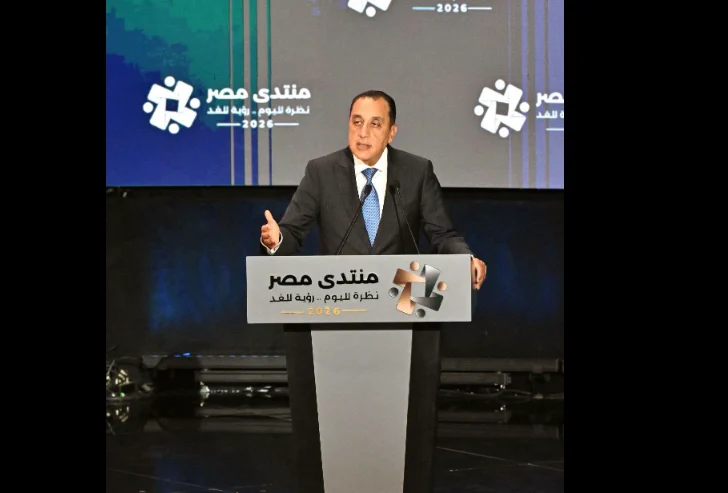
Habi_ Dr. Moustafa Madbouly, Prime Minister, delivered a speech during a session entitled "The National Economic Transformation Program", as part of the activities of the fourth day of the Egypt 2026 Forum, held under the directives of President Abdel Fattah El-Sisi, from October 19 to 24 in the New Capital.
At the outset, the Prime Minister expressed his pleasure in participating in the session to review the features of the National Economic Transformation Program for the period from 2027 to 2030, pointing out that the presentation would cover only the main features of the program due to the volume of details prepared and completed over the past months with the participation of many experts and specialists, the limited time available for its presentation, and the review by the Governor of the Central Bank and relevant ministers of other aspects of the program.
Madbouly pointed out that the government took the comments of experts and specialists into consideration and introduced amendments to the program more than once to address the raised comments until reaching the current version. He added that work will not stop at this stage, as opportunities will be provided for community dialogues regarding the program over the next two months and to put forward new proposals regarding its details, expressing his hope to finalize all its aspects in their final form by the end of next December.
Continuing to explain the features of the National Economic Transformation Program, the Prime Minister indicated that the state has adopted many financial, economic, and structural reform programs in cooperation with several institutions, including the World Bank and the European Union, with the aim of putting the national economy on the right track.
He noted that the latest program with the International Monetary Fund will end by the end of next December, which raised questions from experts regarding the next steps after the end of cooperation with the Fund, necessitating a clarification of the government's objectives at this stage, foremost of which is preserving the economic gains achieved by the Egyptian economy.
Madbouly compared the economic indicators in 2014 and 2026, explaining that the economic growth rate reached 2.9% during the 2013/2014 fiscal year, compared to 5.1% during the 2025/2026 fiscal year, despite current global challenges.
He added that in 2014, the primary balance recorded a deficit equivalent to 3.9%, after excluding debt service, while a primary surplus of 4.9% is currently achieved, reflecting a shift in the public finance position, supported by the implementation of expenditure governance and rationalization policies and the encouragement of the private sector.
The Prime Minister explained that the overall deficit, which represents the difference between revenues and expenditures, reached 12% in 2014, before dropping to 5.8% during the 2025/2026 fiscal year. Foreign exchange reserves also rose from $16.7 billion during the 2013/2014 fiscal year to $57.3 billion by the end of last September, through efforts by the Central Bank of Egypt, while foreign direct investment increased from $4.1 billion annually in 2014 to $18 billion injected into the Egyptian economy over the past year.
Commenting on these indicators, the Prime Minister noted that despite the noticeable improvement, significant structural challenges remain, including the persistence of the overall deficit at 5.8%, the decline in household purchasing power due to inflation and rising prices, as well as the high debt service amounting to EGP 2.3 trillion in the current year's budget, the weak domestic savings rate which represents 3% of the gross domestic product, in addition to population growth, as Egypt's population increased by about 25 million people between 2014 and 2026, imposing additional burdens.
Madbouly explained that with the approaching end of the International Monetary Fund program, it has become necessary to develop a new program, stressing that it was not prepared in a closed room or in isolation from the concerned parties, but rather was prepared according to a participatory and integrative approach, to be an economic transformation program based on existing gains and enhancing coordination between economic policies, through full cooperation between the government and the Central Bank of Egypt.
He pointed out that the government studied international experiences that went through conditions similar to Egypt, and had programs with the IMF and international institutions, before moving to prepare their own national programs. It also benefited from accumulated expertise and previous initiatives, including the National Dialogue, the National Narrative, the Structural Reforms Program, the State Ownership Policy Document, and the recent academic study known as the "Oxford Handbook".
He stressed that the goal is to establish a clear and integrated national economic program that addresses various segments of society, meets the needs of the Egyptian citizen, and gains the confidence of experts and international economic institutions.
The Prime Minister explained the difference between reform and economic transformation, noting that economic reform, according to economic literature, aims to achieve a degree of macroeconomic stability, enhance the economy's ability to adapt to and efficiently handle shocks, alongside achieving exchange rate stability.
Economic Transformation Program aims to increase private sector investments to 67%
In the context of his talk about the program, Madbouly said that experts were inquiring about what is new that the Egyptian program offers, explaining that the economic transformation program aims to raise the economy's productivity, enhance private sector empowerment and its competitiveness, particularly in regional and global supply chains, develop human capital, support the middle class that has suffered during the past period, alongside maximizing returns from assets.
He added that the state has succeeded over the past twelve years in building large assets and infrastructure, and is currently working to maximize the benefit from them and double the fiscal space available for spending on services that touch citizens' lives.
He explained that the program is based on main pillars, including establishing an integrated economic framework that paves the way for a real transformation, achieving consistency between fiscal, monetary, government, and Central Bank of Egypt policies, alongside implementing concrete measures to increase incomes, provide job opportunities, improve services, enhance fiscal space through expenditure governance and directing resources toward human priorities, and increasing revenues by expanding the tax base instead of imposing new taxes.
In this context, the Prime Minister pointed to questions about the nature of governance procedures after the end of the International Monetary Fund program and the extent of their continuation, stressing that these procedures will continue on a broader scale. He added that there will be indicators related to external debt, domestic debt, and sovereign guarantees, alongside instruments for public investments, allowing the private sector to obtain the largest share of investments.
He pointed out that the new program will acquire the character of national obligation through a government decision or a decision issued by the President of the Republic, ensuring clear and specific mechanisms for its follow-up and evaluation, with the participation of concerned entities and groups.
Government aims to raise total investment to 20% of GDP by 2030
Madbouly reviewed the quantitative targets of the program until the 2029/2030 fiscal year, explaining that the government aims to raise the economic growth rate from 5.1% currently to 6.8%, increase the ratio of total investment to gross domestic product from 12.7% to 20%, and raise the share of private sector investments from 57.7% to 67%.
He added that the targets include increasing the ratio of tax revenues to gross domestic product from 13% to 15%, reducing the inflation rate from 13.3% to between 5% and 7%, and shrinking the current account deficit as a percentage of gross domestic product from 5.1% to 2.3%.
Reducing interest payments to 43% of revenues among economic transformation targets
Government aims to reduce unemployment to 5.5% and the current deficit to 2.3% by 2030
He pointed out that interest payments currently represent about 67% to 68% of revenues, and the state aims to reduce this percentage to 43%, alongside continuing to reduce the unemployment rate from 5.8% to 5.5%.
The Prime Minister stressed that achieving these targets depends on a number of pillars, including adherence to exchange rate flexibility, expanding the tax base, enhancing the role of the private sector, reorganizing the state's role in the economy, and focusing on targeted sectors to increase productivity and stimulate exports, contributing to providing better job opportunities for citizens.
He added that the program pays attention to human development by working to provide additional fiscal space in the state's general budget that allows for increased spending on education, health, housing sectors, and other services that citizens look forward to developing during the coming period.
Madbouly explained that the National Economic Transformation Program aims to achieve a tangible improvement in citizens' standard of living through improving incomes, services, and quality of life, increasing employment rates, providing decent job opportunities, and enhancing women's contribution to economic activity.
He added that the program pays special attention to developing basic services, particularly in the education, health, and housing sectors, facilitating citizens' access to them, expanding their electronic availability, while taking into account their cost and ensuring they reach various segments of society.
Prime Minister: Increasing the minimum wage and raising the tax exemption limit within the economic transformation program
The Prime Minister pointed out that the program also includes raising the minimum wage in the public and private sectors, and increasing the personal tax exemption limit for workers nationwide, stressing that these pillars represent the most prominent targets of the program to improve living conditions, enhance citizens' ability to meet their needs, and achieve a direct positive impact on their quality of life.